 Tyagi
TyagiIndia Online Scam Guide: UPI Fraud, Phishing & Fake Customer Care | How to Protect Yourself
India is the fastest growing target for online scams. This master guide covers every major scam type — UPI fraud, phishing, fake customer care, investment scams, job scams, and more — with the exact psychology criminals use and how to stay safe.
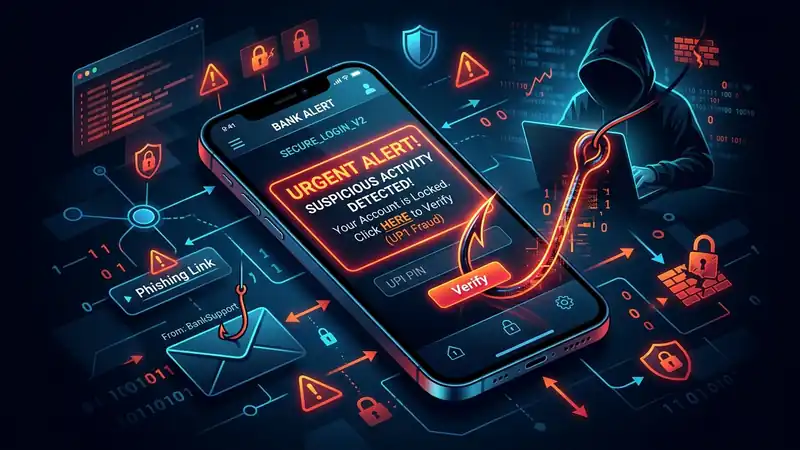
1. Why India Is a Prime Target for Online Scams
India added over 300 million new internet users in the last decade. A massive portion of these new users came online with limited digital literacy, directly into an ecosystem with UPI, digital banking, and social media — all prime targets for scammers. The speed, anonymity, and scale that digital platforms offer makes India one of the most targeted nations for cyber fraud globally.
According to the Indian Cyber Crime Coordination Centre (I4C), Indians lost over ₹7,000 crore to cyber fraud in the first half of 2024 alone — nearly ₹1,300 crore every month. These are only reported cases. The real number is estimated to be 10–15x higher due to under-reporting driven by shame, confusion about whom to contact, and lack of faith in recovery.
2. UPI Fraud — India's Most Widespread Scam
UPI transformed India's payment landscape but also created new fraud vectors that exploit users' unfamiliarity with the technology. UPI scams are responsible for the largest financial losses in India's cyber fraud ecosystem.
🔴 The "Collect Request" Trick
A scammer sends you a UPI collect request (a request for money, not a payment). They disguise it with a message like "Scan to receive ₹5,000 cashback" or "Enter your PIN to receive money." Users who don't understand that entering a UPI PIN deducts money, not receive it, immediately lose funds.
You NEVER need to enter your UPI PIN to receive money. If someone asks you to "scan and enter PIN to receive money" — it is 100% a scam. Decline and report.
🔴 Fake Customer Care Numbers
This is the most lucrative and sophisticated UPI scam. Victims search for customer care numbers of their bank, Paytm, PhonePe, or IRCTC on Google. Fraudsters pay for Google Ads positioning fake numbers at the top of search results. The "customer care agent" then asks you to download a remote access app (AnyDesk, TeamViewer) to "fix the issue" — and uses it to initiate UPI transactions from your phone while you watch.
🔴 Screen Sharing Scams
Criminals call pretending to be telecom operators, bank representatives, or government officials. They request you install screen-sharing apps "to assist with KYC" or "verify your Aadhaar." Once screen sharing is active, they wait for you to open your banking app and capture your PIN, account number, and balance.
🔴 OLX/Facebook Marketplace Fraud
Fake buyers contact sellers on OLX or Facebook Marketplace claiming to be "army officers" or "people stationed abroad" who need to "send payment via UPI." They send a collect request or ask for your UPI ID, then use it for reverse scams where they capture your screen or social engineer you into approving payments.
How to Stay Safe from UPI Scams
Never search customer care numbers on Google. Always go to the official bank website or app. Never scan QR codes sent by unknown people. Never share your UPI PIN with anyone — not even "bank officials."
Never Install Remote Access Apps
No legitimate bank, IRCTC, or government official will ever ask you to install AnyDesk, QuickSupport, or TeamViewer. This request is always a scam — hang up immediately.
3. Phishing — The Art of Digital Deception
Phishing is the practice of creating convincing fake versions of legitimate websites, emails, or SMS messages to steal your login credentials, banking details, or personal information. It is the most common gateway to larger attacks.
📧 Email Phishing
You receive an email appearing to be from your bank, SBI, HDFC, or a service like Amazon or Netflix. The email warns of "suspicious activity" or "account suspension" and provides a link to "verify your account." The link leads to a pixel-perfect fake website that captures everything you type.
📱 Smishing (SMS Phishing)
You receive an SMS: "Your KYC is expired. Click here to update immediately or your account will be blocked: [short URL]." The link leads to a fake banking portal that captures your account credentials. Indian smishing campaigns often target SBI, IPPB, and Jio users with alarming scale.
📞 Vishing (Voice Phishing)
Callers impersonate RBI officers, bank fraud departments, TRAI officials, or even CBI/ED agents. They claim your account is involved in money laundering or suspicious transactions. They create extreme psychological pressure ("your account will be frozen in 2 hours") to bypass your rational thinking.
| Phishing Type | Delivery Method | How to Spot It |
|---|---|---|
| Email Phishing | Fake email from "bank" | Check sender domain — real banks never use Gmail/Yahoo |
| Smishing | SMS with short link | Banks communicate through official IDs (e.g., VM-HDFCBK), never personal numbers |
| Vishing | Phone call | RBI/CBI/ED never calls for account verification. Hang up. |
| Clone Website | Fake URL in email/SMS | Check URL carefully — hdfcbank.com vs hdfcbanks.com |
| WhatsApp Phishing | Fake job/lottery links | No job offer comes via WhatsApp from an unknown number |
4. Investment and Trading Scams — The New Epidemic
Investment fraud has exploded in India, with criminals exploiting the public's desire to participate in the stock market, crypto, and real estate. These scams are meticulously engineered to appear legitimate.
📈 The "Task-Based" Scam
Victims are recruited via WhatsApp or Telegram for "simple online tasks" like giving app ratings or liking YouTube videos for small payments (₹50–500 per task). After building trust with small real payouts, victims are introduced to a "special investment platform" where they must deposit money to get higher-paying tasks. The app shows growing "profits" but all withdrawal attempts require more deposits. It's all fake.
📊 Fake Stock Market Tips Groups
Fraudsters create WhatsApp or Telegram groups impersonating SEBI-registered brokers or famous investors. They share "insider tips" that initially appear to generate profits (they control the fake trading platform). Once victims invest large sums, the platform shows a "loss" or becomes inaccessible.
💰 Pig Butchering Scam (Sha Zhu Pan)
This is the most sophisticated and devastating investment scam. A stranger contacts you (often romantically on dating apps or casually on LinkedIn). Over weeks or months, they build a deep relationship. They eventually introduce you to a "fantastic crypto trading platform" and coach you through initial investments that show massive returns. When you try to withdraw large sums, the app demands "taxes" or "fees" — and then disappears along with your money. Indian victims have lost crores in individual cases.
Any investment platform that guarantees fixed daily/weekly returns, requires deposits to withdraw profits, or is only accessible via a specific app link (not on official app stores) is a SCAM. Legitimate SEBI-registered brokers are listed on sebi.gov.in.
5. Job Scams and Work-From-Home Fraud
With millions of unemployed youth and the work-from-home revolution, job scams have become one of the highest-volume cyber frauds in India. They prey on financial desperation and hope.
🖥️ Data Entry Work-From-Home Scams
Ads on Facebook or WhatsApp promise ₹20,000–40,000/month for simple data entry work from home. Victims are asked to pay a "registration fee" of ₹500–5,000 for "software access" or "training materials." The software never arrives, and the scammer disappears.
🏭 Fake Job Offer Letters
Victims receive convincing job offer letters on real company letterheads (obtained from leaked documents or generated using AI) for positions they applied for. The offer requires paying for "medical clearance," "visa processing," or "security deposit." The job doesn't exist.
📦 Parcel Reshipping Scam (Mule Jobs)
Victims are hired to receive packages and reship them. They don't know the packages contain stolen goods purchased with stolen credit cards. Victims become unwitting accomplices in criminal operations, potentially facing legal consequences.
6. What to Do If You've Been Scammed
Speed is everything. The faster you report, the higher the chance of fund recovery before the money leaves the country.
📞 Call 1930 Immediately
The National Cyber Fraud Helpline 1930 can freeze fraudulent transactions if reported within hours. This is your most powerful tool — use it within the first 30 minutes if possible.
🌐 File Online Complaint
Go to cybercrime.gov.in and file a detailed complaint with transaction IDs, screenshots, and scammer contact details. This feeds into the national database used to track fraud networks.
🏦 Contact Your Bank
Call your bank's fraud line and raise a chargeback or unauthorized transaction dispute. For UPI, contact the UPI app's support. Provide the transaction ID and report it as fraud.
📋 File an FIR
For large amounts or identity-related scams, file an FIR at your local police station. A formal FIR is required for insurance claims and formal bank dispute escalations.
Before doing anything, screenshot every conversation, transaction record, and message from the scammer. Save the scammer's phone number, email, and any website URLs. This evidence is critical for police investigation and fund recovery. WhatsApp conversations can be exported as text files from the app settings.
Discussion & Reviews
Tap stars to rate this page: