
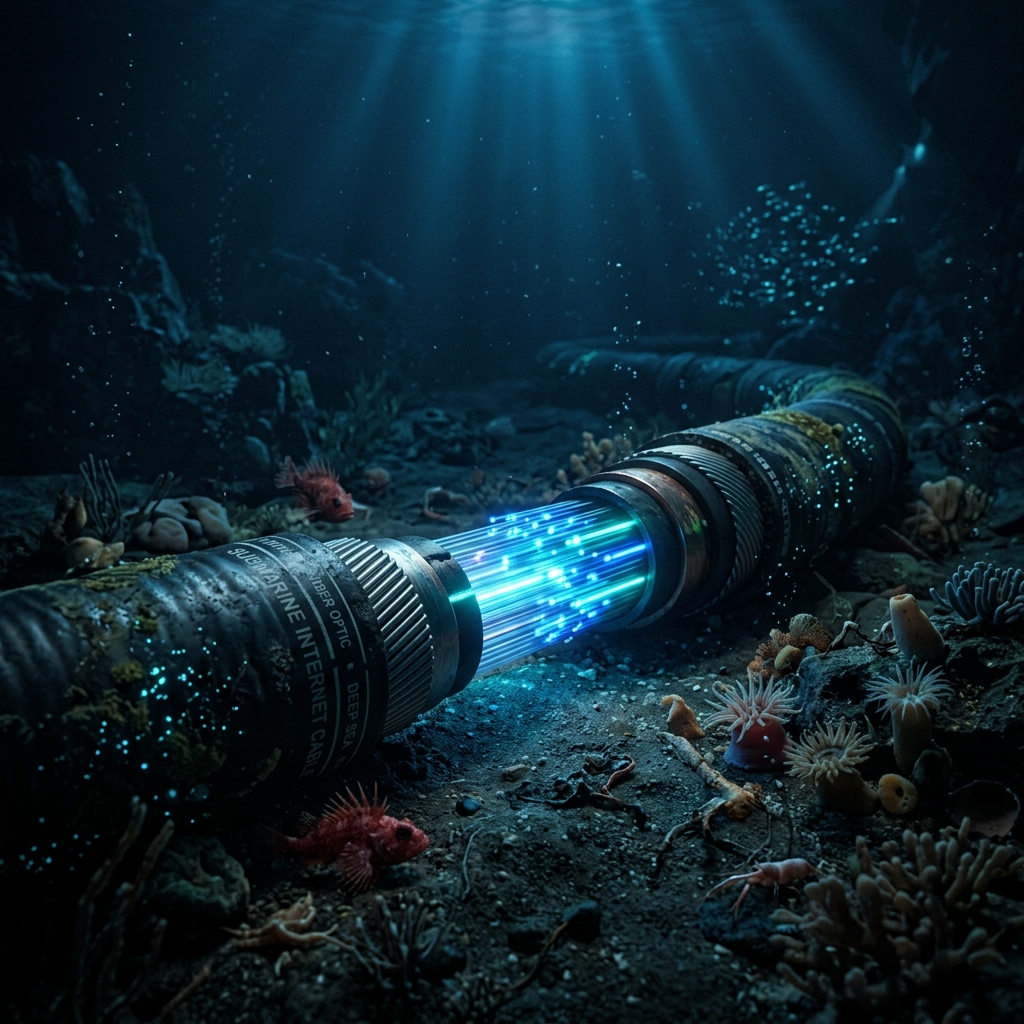
When you send a message on WhatsApp to a friend in the United States or stream a YouTube video uploaded from Japan, you might assume it travels wirelessly through satellites orbiting the Earth. It is a perfectly logical assumption, but it is almost entirely wrong.
The overwhelming majority of global internet traffic — over 99% of all international data — travels not through the sky, but through the deep, cold, dark floors of our oceans. It moves through a vast, spider-web network of submarine fiber-optic cables, some of which are no thicker than a garden hose, stretched across distances of thousands of kilometers at the bottom of the Atlantic, Pacific, and Indian Oceans.
This is the story of one of the greatest engineering achievements in human history: the submarine internet cable system that silently holds the modern digital world together.
A Brief History: From Telegraph to Terabits
The concept of laying cables across the ocean floor is far older than the internet. The very first transatlantic telegraph cable was successfully laid in 1858, connecting Valentia Island in Ireland to Heart's Content, Newfoundland in Canada. Queen Victoria and US President James Buchanan exchanged congratulatory messages — though the cable failed within a month due to electrical over-voltage applied by the chief engineer.
After numerous failed attempts, a permanent transatlantic telegraph cable was finally established in 1866. For the next century, these cables carried telegraph and telephone signals, transforming global communication. The shift to fiber optics began in the 1980s when TAT-8, the first transatlantic fiber-optic cable, went live in 1988 between the US, UK, and France, capable of carrying 40,000 telephone calls simultaneously.
Today, the global submarine cable network comprises over 530 active cables with a combined length exceeding 1.4 million kilometers — enough to wrap around the Earth more than 35 times. These cables are the arteries of the global internet.
The Anatomy of a Submarine Cable: What's Inside?
From the outside, a submarine internet cable looks deceptively simple — just a long, flexible tube. But its internal structure is a marvel of precision engineering designed to survive the crushing pressure, freezing temperatures, and physical hazards of the deep ocean.
A modern submarine cable is built in multiple protective layers, from the inside out:
1. The Core: Optical Fiber Strands
At the heart of every cable are the optical fibers — thin strands of ultra-pure silica glass, each roughly 125 microns in diameter (thinner than a human hair). Data travels through these fibers as precisely modulated pulses of laser light. A single fiber pair can carry an almost unimaginable amount of data. The modern MAREA cable between the US and Spain, for example, has a design capacity of 200 terabits per second — enough to simultaneously stream 200 million HD videos.
2. The Electrical Power Conductor
Optical fibers carry light, not electricity. However, the signal amplifiers placed along the cable route (called "repeaters") need electrical power to function. A copper wire layer within the cable carries high-voltage DC current (up to 15,000 volts) from the cable landing stations on shore to power all the repeaters along the entire cable route.
3. Steel Wire Armor (Near Coastlines)
The sections of a submarine cable near the shore — in shallow water — are the most vulnerable to damage from ship anchors, fishing trawlers, and underwater currents. In these zones, the cable is wrapped in one or two layers of high-tensile steel wire armor to provide physical protection. These armored sections can be 5 to 7 centimeters thick.
4. Deep-Sea Lightweight Design
In deep ocean waters (below 1,000 meters), the threat from human activity is minimal. The cable here sheds its heavy armor and becomes much thinner and more lightweight — roughly 2 to 3 centimeters in diameter, about the width of a standard garden hose. This dramatically reduces the weight and cost of the cable in the sections that make up 95% of its total length.
How the Signal Travels: Repeaters and Amplification
Light traveling through a glass fiber does not travel indefinitely without loss. As it travels, the light signal gradually weakens — a phenomenon known as "attenuation." For long-distance submarine cables, signal amplification is a critical engineering challenge.
To combat this, submarine cables contain underwater signal amplifiers known as repeaters, placed at intervals of approximately 60 to 100 kilometers along the cable route. Each repeater uses a device called an Erbium-Doped Fiber Amplifier (EDFA). In an EDFA, the incoming weakened light signal passes through a section of glass fiber doped with the rare-earth element Erbium. A pump laser within the amplifier excites the Erbium atoms, which then release extra photons of the same wavelength and phase as the incoming signal, effectively amplifying it without converting it into an electrical signal. This all-optical amplification is incredibly efficient and introduces minimal signal distortion.
A single transatlantic cable may contain 50 to 100 repeaters, all powered by the copper conductor carrying high-voltage DC electricity from the shore.
How Cables are Laid: The Cable Ships
Laying a submarine cable is one of the most complex logistical operations in civil engineering. Specialized vessels called cable laying ships are used for this purpose. These ships — such as the Alcatel Submarine Networks' "Ile de Bréhat" or Subcom's "Reliance" — are massive vessels equipped with enormous cable tanks (called "cable carousels") that can hold up to 10,000 km of coiled cable.
- Route Survey: Before a single meter of cable is deployed, oceanographic teams conduct detailed surveys using sonar and autonomous underwater vehicles (AUVs) to map the ocean floor, identify seismic fault lines, underwater mountains, and areas with heavy fishing or shipping activity that the cable route must avoid.
- Shallow Water Burial: In coastal zones up to about 1,000 meters deep, a specialized underwater plow (called a "cable plow" or "jetting sled") is towed along the seabed, cutting a trench and burying the cable 1 to 3 meters below the seafloor. This protects it from anchors and trawling nets.
- Deep Water Deployment: In deep water, the cable is simply laid on the ocean floor directly from the ship's stern at a controlled rate as the ship moves forward. The cable feeds out over a specially designed "cable engine" that controls tension, ensuring the cable doesn't snap under its own weight.
The Biggest Threats: What Breaks Submarine Cables?
Although submarine cables are built to be extraordinarily durable, they do break — and when they do, the consequences for internet connectivity in affected regions can be significant.
Studies show that approximately 100 to 150 cable faults are repaired globally every year. The most common causes are:
- Ship Anchors and Fishing Trawlers (75% of all faults): The single biggest threat to submarine cables is human activity in shallow coastal waters. A ship dragging its anchor can easily sever a cable. Similarly, deep-sea fishing trawlers dragging heavy nets across the seabed cause significant damage.
- Submarine Landslides (Turbidity Currents): Underwater sediment flows — often triggered by earthquakes — can be powerful enough to snap cables. The 2006 Hengchun earthquake near Taiwan triggered underwater landslides that snapped multiple cables simultaneously, disrupting internet connectivity across much of Southeast Asia.
- Shark Bites: Sharks have been known to bite submarine cables, attracted by the weak electromagnetic fields generated by the power conductors. While rarely the sole cause of a complete cable break, bite marks have been found on recovered cable sections.
Who Owns Submarine Cables? A Shift Towards Tech Giants
Historically, submarine cables were owned and operated by large international telecommunications consortiums. However, a dramatic ownership shift has occurred in the last decade. Major technology companies — primarily Google, Meta (Facebook), Microsoft, and Amazon — have been directly investing in and co-owning private submarine cable systems.
Google alone has invested in over 20 submarine cable systems globally, including the EQUIANO cable (connecting Portugal and South Africa), the FIRMINA cable (one of the longest cables in the world, connecting the US and Argentina), and the CURIE cable (connecting the US to Chile and Panama). This vertical integration allows tech giants to control their own data routing, reduce reliance on third-party telecommunications providers, and dramatically cut latency for their global cloud and content delivery services.
The Future: Space Cables vs. Satellite Alternatives?
Low-Earth Orbit (LEO) satellite internet systems, like Elon Musk's Starlink, are often discussed as potential replacements for submarine cables. The reality is far more nuanced. While LEO satellites have significantly lower latency than traditional geostationary satellites, they still cannot match the raw data capacity of modern fiber-optic cables. A single submarine cable system can carry data at rates thousands of times greater than any current satellite constellation.
The future of global internet infrastructure will be a hybrid model: submarine cables handling the massive bulk data transfer between continents, while satellite systems serve as a crucial backup and provide access to remote, landlocked, and underserved communities that a physical cable can never economically reach.
Frequently Asked Questions (FAQ)
Q: How many submarine internet cables exist in the world today?
As of 2026, there are over 530 active submarine cable systems worldwide, spanning a total length of more than 1.4 million kilometers. New cables are constantly being planned, funded, and deployed as global internet demand grows.
Q: Do submarines or divers ever accidentally hit internet cables?
Military submarines are generally aware of cable routes and navigate carefully. The risk of accidental severance from a submarine is very low. Deep-sea cables are also often laid in areas away from major naval activity. Repair ships and ROVs (Remotely Operated Vehicles) are used to fix cables on the ocean floor when breaks do occur.
Q: How long does it take to repair a broken submarine cable?
The time to repair a submarine cable fault depends heavily on its location. A shallow-water fault near a coast might take 1–2 weeks. A deep-ocean fault could take 3–4 weeks or more, as a specialized repair ship must travel to the exact location, carefully grapple the cable up from the ocean floor, bring it to the surface, splice in a new section, and re-lay it. The cost of a single repair operation can exceed $1 million USD.
Q: Why not use satellites for all international internet traffic instead of cables?
Satellites simply cannot match the data capacity of submarine cables. A single modern submarine cable can carry 200+ terabits per second. The entire global satellite constellation currently has a fraction of this capacity. For bulk data transfer (which makes up the vast majority of internet traffic), submarine cables remain irreplaceable for the foreseeable future.
Q: How deep are submarine internet cables on the ocean floor?
This varies significantly. The deepest sections of cable lie in ocean trenches that can be over 8,000 meters (8 km) below the surface. At such extreme depths, water pressure is over 800 times the pressure at sea level. The cables are specifically engineered with a pressure-resistant polyethylene sheathing to withstand this immense force without being crushed.
Q: Can a country cut submarine internet cables to attack another country?
Submarine cables are widely recognized as critical global infrastructure, and deliberate cutting in international waters would be considered an act of aggression under international maritime law. However, the risk is taken seriously by governments. Many nations now have military and intelligence protocols for monitoring and protecting key cable routes, and redundancy is built into the global cable network so that a single cut does not cause a complete internet blackout.