
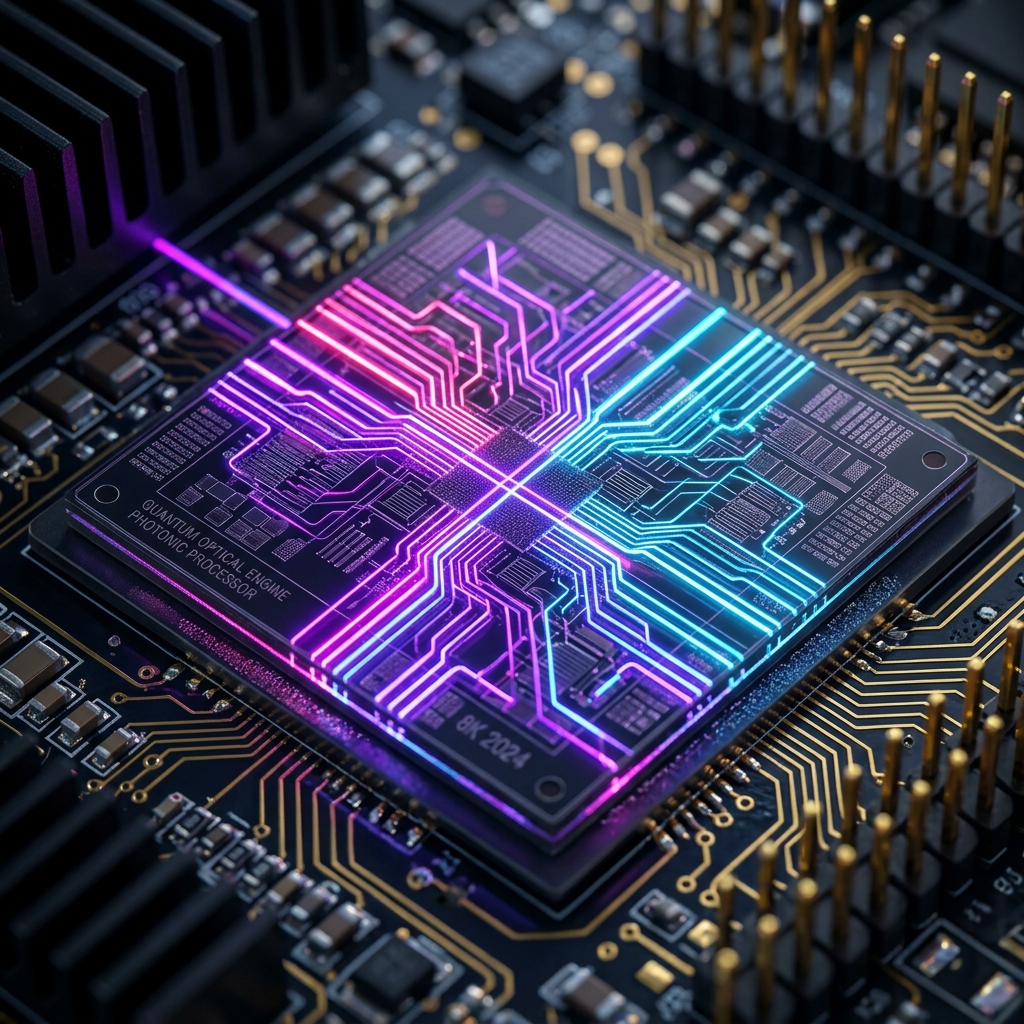
Inside every computer, smartphone, and server running today, electricity is doing all the heavy lifting. Billions of transistors — tiny electronic switches — flip on and off billions of times per second, representing the ones and zeros that form the foundation of all digital computing. This is the architecture that has powered the digital revolution for over seven decades.
But this architecture is hitting a fundamental physical wall. Electrons, the particles that carry electrical current, generate heat when they move through a conductor, and the faster and more densely you pack them, the more heat they produce. We are approaching a point where silicon transistors simply cannot be made any smaller or faster without melting themselves.
The solution that physicists and engineers have been developing for years is radical in its simplicity: replace electrons with photons — use light instead of electricity. This is the field of photonic computing, and it may represent the most fundamental transformation in the history of computing.
The Core Problem with Electrons: Heat and Speed
To understand why photonic computing is so promising, it is essential to first understand the fundamental limitations of electronic computing.
Gordon Moore, co-founder of Intel, observed in 1965 that the number of transistors on a microchip doubles approximately every two years — a trend that became known as Moore's Law. For decades, this held remarkably true, giving us increasingly powerful computers at lower costs.
However, the physical limits of silicon are now becoming insurmountable for traditional electronic processors:
- Heat Generation: When electrons move through a conductor, they collide with atoms, losing energy as heat (a phenomenon described by Joule's Law). Modern processors can generate heat densities comparable to the surface of the Sun if cooling systems are not employed. Data centers globally consume enormous amounts of electricity — and an equal or greater amount for cooling alone.
- Interconnect Bottleneck: Even if processors get faster, the copper wires (interconnects) carrying data between chips and components become the bottleneck. Electrical signals in copper wires travel at roughly 50–80% the speed of light, and they suffer from capacitance and resistance at high speeds.
- Quantum Tunneling: When transistors shrink below 5 nanometers, electrons begin to "tunnel" through barriers they should not physically be able to cross, due to quantum mechanical effects. This causes electrical leakage and unpredictable errors.
What is Photonic Computing? The Core Concept
Photonic computing, also called optical computing, uses photons — the fundamental particles of light — to represent, transmit, and process data instead of electrons. The goal is to build logic gates, memory systems, and processing units that operate using light rather than electrical signals.
This is not the same as using fiber-optic cables to transmit data between computers (which is already commonplace). True photonic computing would use light to actually perform calculations inside a processor — in the same way transistors perform calculations in electronic chips today.
How Data is Represented in Light
In electronic computing, data is represented as binary: a transistor is either ON (1) or OFF (0). In photonic computing, data can be represented in several ways using light:
- Presence or Absence of Light: A photon (light on) equals 1; no photon (light off) equals 0. This is the most direct analog to electronic binary.
- Wavelength (Color): Different wavelengths of light can carry different data channels simultaneously through the same optical fiber — a technique called Wavelength Division Multiplexing (WDM). This allows a single optical channel to carry multiple data streams in parallel, a capability that electrons in a copper wire cannot replicate.
- Polarization: Light waves can oscillate in different planes (horizontal or vertical polarization), providing an additional dimension for encoding information.
Silicon Photonics: Where Light Meets the Chip
The most commercially viable and actively developed branch of photonic computing is silicon photonics. Rather than building entirely new optical chips from scratch, silicon photonics integrates optical components directly onto standard silicon semiconductor chips — using the same manufacturing techniques (CMOS fabrication) used to make conventional processors.
This approach is revolutionary because it means photonic capabilities can be added to existing chip designs without requiring entirely new factories or radically new materials.
Key Components of a Silicon Photonic Chip
A silicon photonic chip contains several key optical components, each performing a specific function:
- Laser Source: A laser diode generates the coherent light that carries data. In current designs, external lasers (often made from Indium Phosphide) are attached to the silicon chip, as silicon itself is not an efficient light emitter. Researchers are working on integrating lasers directly on-chip.
- Optical Waveguides: These are nanoscale channels etched into the silicon that guide light from one component to another, acting as the "wires" of the optical chip. They are typically 200–500 nanometers wide.
- Modulators: These components take an electrical signal (from external sensors or logic circuits) and encode it onto a light beam by rapidly switching the light on and off or changing its phase. Modern silicon optical modulators can operate at speeds exceeding 100 Gigabits per second.
- Photodetectors: At the receiving end, photodetectors convert the incoming light signal back into an electrical signal for processing. They are typically made from Germanium grown on silicon.
Photonic vs. Electronic Computing: A Direct Comparison
| Property | Electronic Computing | Photonic Computing |
|---|---|---|
| Carrier Particle | Electron | Photon (light) |
| Speed | ~50–80% speed of light in copper | Speed of light in medium (near 200,000 km/s) |
| Heat Generation | High (due to electrical resistance) | Negligible (photons have no charge) |
| Bandwidth | Limited by conductor capacity | Massive (WDM allows many parallel channels) |
| Interference | Subject to electromagnetic interference (EMI) | Immune to electromagnetic interference |
| Energy per Bit | Higher (charging capacitors) | Significantly lower |
| Maturity | Highly mature, 70+ years of development | Emerging — commercially early stage |
Real-World Applications Being Developed Right Now
Photonic computing is not purely theoretical. Several concrete, real-world applications are already in early commercial deployment or advanced research stages:
1. Photonic Interconnects in Data Centers
The most mature application of silicon photonics is replacing the copper cables and electrical interfaces that connect servers, chips, and storage systems inside large data centers. Companies like Intel, IBM, and Cisco have deployed commercial silicon photonic transceivers that connect server racks using light instead of electricity, dramatically increasing data transfer rates while reducing power consumption. This is arguably already in widespread use today.
2. AI and Neural Network Acceleration
Training large AI models (like large language models) requires performing an immense number of matrix multiplication operations. MIT researchers and startup companies like Lightmatter and Luminous Computing have developed photonic chips specifically designed to perform matrix multiplication using light. In optical matrix multiplication, light beams are physically manipulated using optical components to produce the mathematical result at the speed of light — a task that is both faster and more energy-efficient than performing the same calculation on a conventional GPU.
3. LIDAR Systems in Self-Driving Cars
Modern autonomous vehicles use photonic integrated circuits (PICs) in their LIDAR (Light Detection and Ranging) systems to precisely map their environment using laser light. Photonic chips allow LIDAR systems to become smaller, cheaper, and more power-efficient than traditional mechanical LIDAR systems.
The Remaining Challenges
Despite its immense promise, photonic computing faces significant engineering hurdles that explain why it has not yet fully replaced electronic computing:
- Optical Memory: Storing data optically (creating an "optical RAM") is far more difficult than storing electrical charge in a capacitor. Current photonic systems still rely on electronic memory, limiting their full optical potential.
- Fan-out and Logic Gates: Building complete optical logic gates (AND, OR, NOT) that can be miniaturized and efficiently integrated remains an active research challenge. Optical signals do not interact with each other naturally (unlike electrons in transistors), requiring clever physical setups using nonlinear optical materials.
- Integration Cost: Manufacturing hybrid photonic-electronic chips that seamlessly combine both optical and electronic components on a single substrate remains complex and expensive at scale.
Frequently Asked Questions (FAQ)
Q: Is photonic computing the same as quantum computing?
No, they are fundamentally different technologies. Photonic computing uses ordinary (classical) light to represent and process binary data (0s and 1s) at very high speeds. Quantum computing uses quantum mechanical phenomena (superposition and entanglement) to perform a completely different type of computation on quantum bits (qubits). Some quantum computing approaches do use photons as qubits, but classical photonic computing and quantum computing are distinct fields with different goals.
Q: When will we have fully photonic computers available commercially?
A fully optical computer — where light performs every function including memory and logic — is still many years away from consumer availability. However, hybrid systems where photonic interconnects and photonic AI accelerators are integrated with conventional electronic processors are already available in specialized data center and research environments as of 2026, and this market is expected to grow rapidly.
Q: Why can't we just use fiber-optic cables everywhere and call it photonic computing?
Using fiber-optic cables to transmit data between devices (like in internet infrastructure) is called optical communications or photonic networking — it is already ubiquitous. True photonic computing specifically refers to using light to perform the actual computations (arithmetic, logic operations) inside a processing unit, not just to carry data between separate electronic processors. The distinction lies in where and how the light is used.
Q: Which companies are leading the development of photonic computing?
Several organizations are at the forefront of this field. In terms of startups, Lightmatter (US), Luminous Computing (US), and PsiQuantum (which uses photonics for quantum computing) are notable. Among established corporations, Intel has a significant silicon photonics division, IBM Research is actively working on optical interconnects, and NVIDIA has expressed strong interest in photonic technology for AI acceleration due to its energy efficiency advantages.
Q: Does photonic computing work better for some tasks than others?
Yes. Photonic computing is particularly well-suited for tasks involving massive parallel data processing, such as AI inference, neural network computation, signal processing, and certain encryption operations. Tasks that require reading and writing to memory very frequently, or complex branching logic, are still better handled by electronic processors. This is why the most promising near-term approach is a hybrid photonic-electronic architecture where each technology handles the tasks it is best suited for.
Q: How does using light reduce energy consumption in computing?
In electronic computing, significant energy is consumed charging and discharging the capacitance in metal interconnects and transistor gates — energy that is ultimately dissipated as heat. Photons have zero electrical charge and effectively zero rest mass, so they can travel through optical waveguides with minimal energy loss to heat. Optical data transmission requires only the energy needed to generate and detect the light signal itself, which can be orders of magnitude less than the energy required to drive an equivalent electrical signal through a copper wire at the same data rate and distance.