 Tyagi
Tyagi
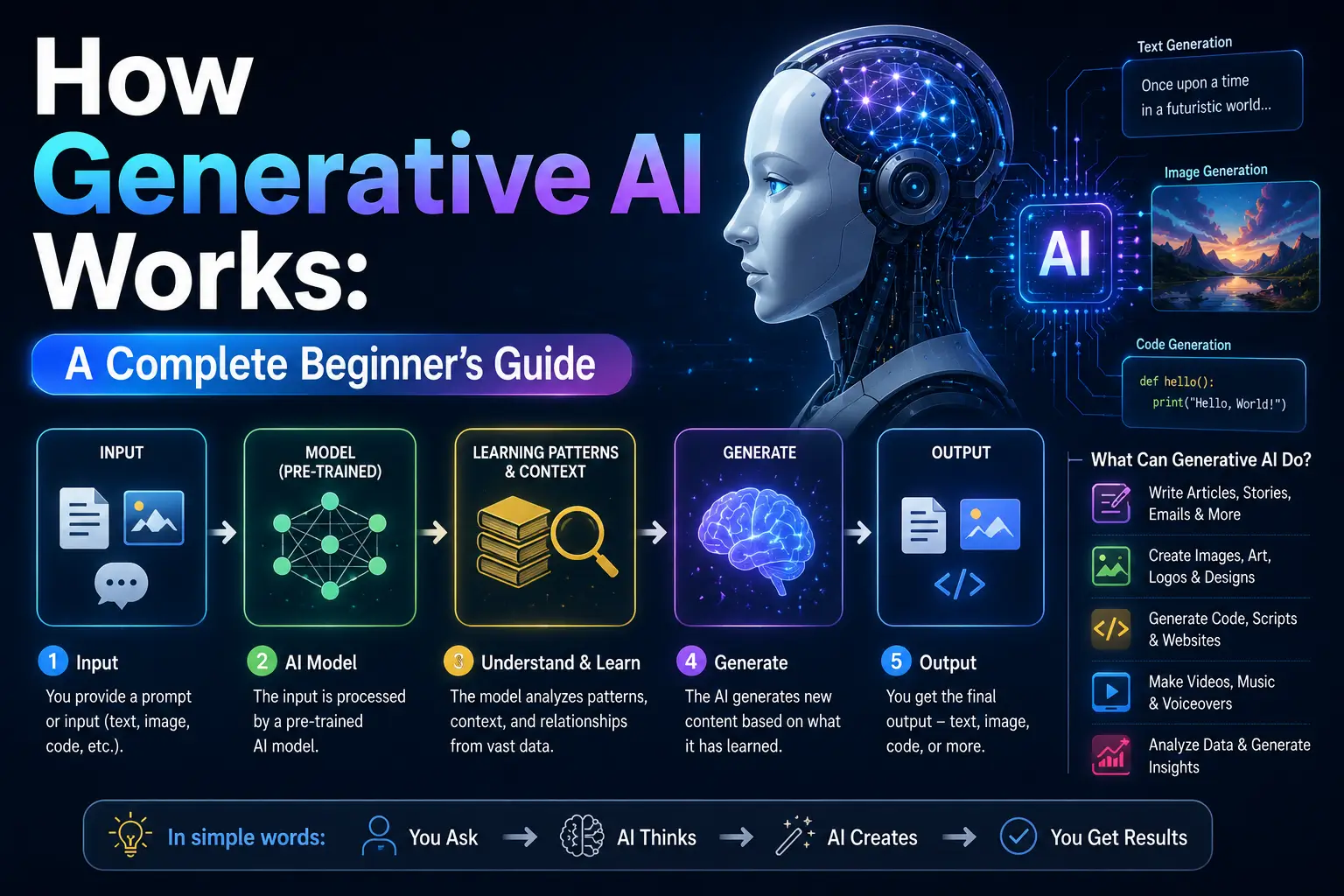
How Generative AI Works: A Complete Beginner's Guide
Understand how generative AI models like ChatGPT, Midjourney, and Sora actually work — from neural networks and transformers to diffusion models, explained simply.
- 1. What is Generative AI?
- 2. The Foundation — Neural Networks
- 3. Transformers — The Architecture Behind LLMs
- 4. Tokens — How AI Reads and Writes Text
- 5. How These Models Are Trained
- 6. Next-Word Prediction — The Core Trick
- 7. How Image Generation Works (Diffusion Models)
- 8. Multimodal AI — Combining Text, Image, Audio
- 9. Why AI "Hallucinates"
- 10. Using Generative AI Effectively
1. What is Generative AI?
Generative AI refers to artificial intelligence systems capable of creating new content — text, images, audio, video, or code — rather than simply analyzing or classifying existing content. When you ask ChatGPT a question and it writes a thoughtful response, or you type a description into Midjourney and get a stunning image, you're witnessing generative AI in action.
This represents a fundamental shift from earlier AI systems, which were primarily designed for classification tasks (is this email spam or not, is this image a cat or a dog) toward systems that can produce genuinely novel output. Understanding the mechanics behind this capability demystifies what often feels like magic and helps you use these tools more effectively and with appropriately calibrated trust.
2. The Foundation — Neural Networks
Every generative AI system is built on neural networks — computational structures loosely inspired by how biological brains process information, though the comparison shouldn't be taken too literally. A neural network consists of layers of interconnected "nodes" (sometimes called neurons), where each connection has an associated "weight" that determines how much influence one node has on another.
During training, these weights are adjusted millions or billions of times based on how well the network's output matches the desired result. This process — called backpropagation combined with gradient descent — is the mathematical engine that allows a neural network to gradually improve at a task, whether that's recognizing images, translating languages, or generating coherent text.
Deep Learning
"Deep" learning simply refers to neural networks with many layers (sometimes hundreds) stacked on top of each other. Each layer learns increasingly abstract representations of the input data — early layers might detect simple patterns like edges in an image or word frequencies in text, while deeper layers combine these into increasingly sophisticated concepts.
3. Transformers — The Architecture Behind LLMs
The Transformer architecture, introduced in a landmark 2017 research paper titled "Attention Is All You Need," is the single most important breakthrough enabling today's large language models (LLMs). Virtually every major AI chatbot — ChatGPT, Claude, Gemini — is built on Transformer-based architectures.
The Self-Attention Mechanism
The key innovation in Transformers is "self-attention" — a mechanism that allows the model to weigh the importance of different words in a sentence relative to each other, regardless of their distance apart. For example, in the sentence "The trophy didn't fit in the suitcase because it was too big," the model needs to determine whether "it" refers to the trophy or the suitcase. Self-attention allows the model to look at all the words simultaneously and learn these relationships, rather than processing word-by-word in strict sequence as older architectures did.
Why This Was Revolutionary
Previous architectures (like RNNs and LSTMs) processed text sequentially, one word at a time, making them slow to train and prone to "forgetting" information from earlier in long passages. Transformers process all words in parallel and maintain relationships across the entire input through attention, making them dramatically more efficient to train at scale and far better at maintaining coherence over long passages.
Self-Attention
Each word "looks at" every other word to understand context and relationships, weighted by relevance.
Multiple Layers
Modern models stack dozens to hundreds of transformer layers, each refining understanding further.
Parameters
The learned weights — billions of numbers — that encode everything the model has learned during training.
Parallelization
Unlike older sequential models, transformers process entire sequences simultaneously, enabling massive scale.
4. Tokens — How AI Reads and Writes Text
AI models don't process text as humans read it — letter by letter or word by word. Instead, text is broken into "tokens," which can be whole words, parts of words, or even single characters, depending on how common they are in the training data.
For example, the common word "the" might be a single token, while a rarer or compound word like "tokenization" might be split into multiple tokens like "token" + "ization." This tokenization process allows models to handle any text — including made-up words, typos, or text in multiple languages — by breaking it into manageable, learnable pieces.
| Text | Approximate Tokens | Why |
|---|---|---|
| "Hello" | 1 token | Very common word, has its own token |
| "unbelievable" | 2-3 tokens | Split into common sub-parts like "un" + "believ" + "able" |
| "नमस्ते" (Hindi) | 2-4 tokens | Non-Latin scripts often require more tokens per word |
| "GPT-4o" | 3-4 tokens | Technical/brand terms often split unpredictably |
This is why AI services often price usage by "tokens" rather than words or characters — and why the same sentence in Hindi or another non-English language can sometimes cost more to process than its English equivalent, since current tokenization schemes were optimized primarily on English-heavy training data.
5. How These Models Are Trained
Training a large language model happens in distinct phases, each building on the previous:
Phase 1: Pre-training
The model is shown massive amounts of text — essentially a significant fraction of publicly available internet text, books, articles, and code — and trained on a simple task: predict the next word (token) given the preceding context. This phase requires enormous computational resources, often costing tens to hundreds of millions of dollars in compute for frontier models, and can take months even on massive supercomputing clusters.
Phase 2: Supervised Fine-Tuning (SFT)
After pre-training gives the model broad language understanding, it's fine-tuned on curated examples of high-quality question-answer pairs, demonstrating the kind of helpful, well-structured responses the model should produce, rather than just continuing text in any direction.
Phase 3: Reinforcement Learning from Human Feedback (RLHF)
Human reviewers rate different model outputs for the same prompt, and this feedback trains a "reward model" that helps further refine the AI's behavior to be more helpful, honest, and aligned with human preferences — reducing harmful, biased, or unhelpful outputs.
6. Next-Word Prediction — The Core Trick
At its mathematical core, a large language model is essentially an extraordinarily sophisticated next-word prediction engine. Given a sequence of text, it calculates a probability distribution over its entire vocabulary for what token should come next, then selects one (often with some randomness for variety) and repeats the process.
What makes this simple-sounding mechanism produce seemingly intelligent, coherent, and even creative output is the sheer scale and sophistication of the patterns learned during training. To accurately predict the next word in billions of diverse sentences, the model has implicitly had to learn grammar, facts about the world, reasoning patterns, and even something resembling abstract concepts — not because it was explicitly taught these things, but because learning them was necessary to get good at the prediction task.
This doesn't mean the model "understands" in the way humans do — there's ongoing scientific and philosophical debate about what's actually happening internally. But functionally, the next-word prediction objective, combined with massive scale, produces remarkably capable and useful behavior.
7. How Image Generation Works (Diffusion Models)
Tools like Midjourney, DALL-E, and Stable Diffusion use a fundamentally different architecture called diffusion models, though they're often paired with transformer-based text understanding to interpret your prompt.
The Diffusion Process
Diffusion models are trained by taking real images and progressively adding random noise until the image becomes pure static, then training the model to reverse this process — predicting and removing noise step by step. Once trained, the model can start from pure random noise and gradually "denoise" it into a coherent image, guided by your text prompt at each step to steer the result toward what you described.
Video Generation
Tools like Sora and Runway extend diffusion concepts into the temporal dimension, generating consistent sequences of frames that maintain coherent motion, lighting, and object identity across time — a substantially harder problem than single-image generation, requiring the model to understand physics-like consistency across the generated sequence.
8. Multimodal AI — Combining Text, Image, Audio
The newest frontier models are "multimodal" — capable of understanding and generating across multiple types of content simultaneously. A multimodal model can look at an image you upload, understand spoken audio, read text, and generate appropriate responses in any combination of these formats. This is achieved by training models on datasets that pair different modalities together (images with their captions, audio with transcripts) so the model learns shared representations that bridge these different types of information.
9. Why AI "Hallucinates"
One of the most important things to understand about generative AI is why it sometimes confidently states incorrect information — a phenomenon called "hallucination." This isn't a bug to be simply patched; it's a direct consequence of how these models fundamentally work.
Since the model generates text by predicting statistically likely next words rather than retrieving verified facts from a database, it can produce fluent, grammatically correct, confident-sounding text that is factually wrong — especially for obscure facts, specific numbers, citations, or events that were underrepresented or absent in training data. The model has no inherent mechanism to distinguish "this is something I learned with high confidence" from "this is a plausible-sounding completion I'm generating."
Always verify specific facts, statistics, citations, and quotes generated by AI, especially for anything important. Use AI for drafting, brainstorming, and explaining concepts, but cross-check specific factual claims independently — particularly for academic, legal, medical, or financial decisions.
10. Using Generative AI Effectively
Understanding the underlying mechanics covered in this article translates directly into practical tips for getting better results:
- Be specific in prompts: Since the model is predicting likely continuations based on your input, more specific and detailed prompts narrow the probability space toward what you actually want
- Provide examples: Showing the model an example of the format or style you want dramatically improves output quality (called "few-shot prompting")
- Break complex tasks into steps: Asking the model to "think step by step" leverages how the sequential generation process can build toward better reasoning
- Verify factual claims independently: Given the hallucination risk, treat AI output as a draft requiring verification, not a definitive source
- Iterate rather than expecting perfection on the first try: Refining your prompt based on initial output usually yields much better results than a single attempt
Generative AI isn't magic — it's sophisticated statistical pattern matching at an unprecedented scale, trained on an enormous fraction of human-written text and other media. Understanding this demystifies both its remarkable capabilities and its genuine limitations, helping you use it as a powerful tool rather than either blindly trusting or dismissively underestimating it.
Discussion & Reviews
Tap stars to rate this page: