 Tyagi
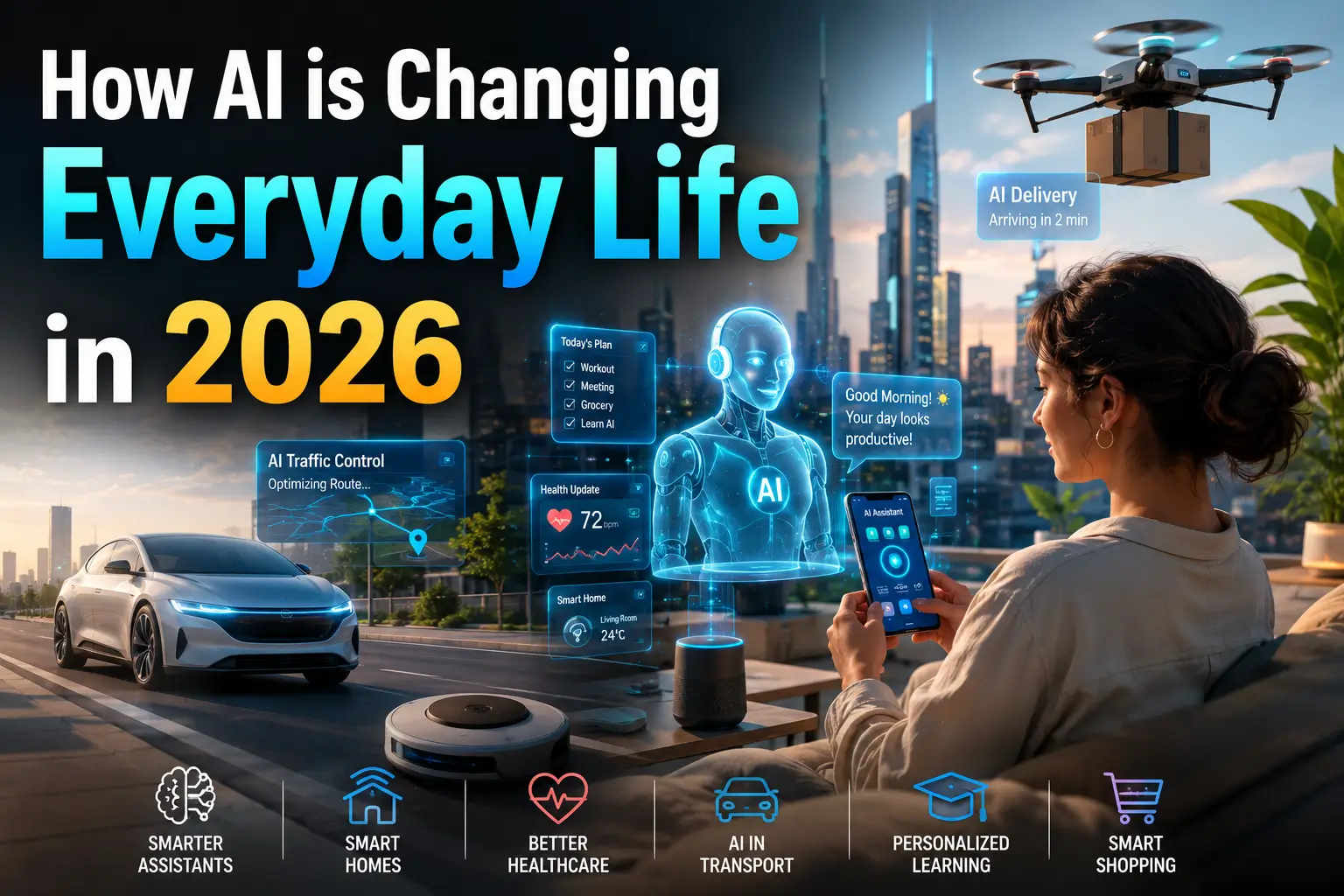
TyagiHow AI is Changing Everyday Life in 2026
Explore how Artificial Intelligence is transforming healthcare, education, finance, transportation, and daily routines — and what it means for India's future.
- 1. The AI Revolution Has Already Arrived
- 2. AI in Your Daily Digital Life
- 3. AI Transforming Healthcare
- 4. AI Reshaping Education
- 5. AI in Banking and Finance
- 6. AI and Transportation
- 7. AI's Impact on India Specifically
- 8. AI and the Future of Jobs
- 9. Risks and Ethical Concerns
- 10. How to Prepare for an AI-Driven World
1. The AI Revolution Has Already Arrived
Artificial Intelligence is no longer a futuristic concept reserved for science fiction movies or research labs. It is embedded in the fabric of everyday life — quietly working behind the scenes every time you unlock your phone with your face, ask a voice assistant for directions, receive a personalized recommendation on YouTube, or get a fraud alert from your bank at the exact moment an unusual transaction occurs.
The pace of AI advancement has accelerated dramatically since 2022. Large language models, image generators, reasoning engines, and multimodal AI systems have gone from research curiosities to consumer products used by hundreds of millions daily. In 2026, AI is not on the horizon — it is here, and understanding it is no longer optional for anyone who wants to navigate the modern world effectively.
2. AI in Your Daily Digital Life
Before we even get to industry-level transformations, let's look at the AI that's already part of your personal daily routine — whether you realize it or not:
Voice Assistants
Google Assistant, Siri, and Alexa use AI-powered natural language processing to understand your spoken commands, manage schedules, control smart home devices, and answer questions conversationally.
Smartphone AI
Face unlock (neural network recognition), camera scene optimization, predictive text, battery management, and spam call filtering — all run on on-device AI chips called NPUs (Neural Processing Units).
Content Recommendations
YouTube, Netflix, Spotify, Instagram — their recommendation algorithms use deep learning models that analyze your behavior to predict what you'll watch, listen to, or engage with next with remarkable accuracy.
Search Engines
Google's AI (including BERT, MUM, and newer multimodal models) powers search to understand context and intent behind your query, not just keyword matching. AI Overviews now summarize search results directly.
AI Chatbots
ChatGPT, Gemini, Claude, and their competitors are now used daily for writing, coding, research, problem-solving, and learning — representing the most direct human-AI interaction in history.
Shopping Intelligence
Amazon, Flipkart, and Meesho use AI for product discovery, dynamic pricing, demand forecasting, fraud prevention, and customer service chatbots — every step of the shopping journey is AI-optimized.
3. AI Transforming Healthcare
Healthcare is arguably the domain where AI has the most profound positive potential — and is already delivering remarkable results:
Medical Image Analysis
AI models trained on millions of medical images can detect diseases in X-rays, CT scans, and MRIs with accuracy comparable to or exceeding specialist radiologists. Google's DeepMind has developed AI that detects over 50 eye conditions from retinal scans. In India, startups like Niramai are using AI-based thermography to detect early-stage breast cancer non-invasively — a breakthrough for regions with limited mammography access.
Drug Discovery Acceleration
Traditional drug discovery takes 10-15 years and billions of dollars. AI is compressing this dramatically. AlphaFold (DeepMind) solved the decades-old protein folding problem, providing the 3D structure of virtually all known proteins — fundamentally accelerating drug design. AI platforms can now screen billions of molecular compounds in silico to identify promising drug candidates in weeks instead of years.
Remote Health Monitoring
Smartwatches and health bands equipped with AI algorithms can now detect atrial fibrillation (an irregular heart rhythm), measure blood oxygen levels, detect sleep apnea, estimate blood pressure trends, and even preliminary detect falls and alert emergency contacts. For India's rural population with limited hospital access, these AI-enabled devices represent a genuine healthcare revolution.
AI-Assisted Diagnosis in India
With India facing a severe shortage of specialist doctors, AI diagnostic tools are being deployed in primary health centers (PHCs) to assist ASHA workers and general physicians. AI tools that can identify tuberculosis from chest X-rays, screen for diabetic retinopathy from fundus photographs, and detect skin conditions from smartphone photos are being piloted across multiple Indian states under the Ayushman Bharat Digital Mission framework.
AI doesn't replace doctors — it gives doctors superpowers. A radiologist with AI assistance can read 40% more scans per day, catch errors they might have missed at the end of a long shift, and prioritize urgent cases that AI flags for immediate attention.
4. AI Reshaping Education
Education is undergoing its most significant transformation since the invention of the printing press, driven by AI's ability to personalize learning at scale:
Personalized Learning Paths
AI tutoring systems like Khan Academy's Khanmigo, BYJU'S AI tutor, and platforms like Duolingo use machine learning to identify each student's strengths, weaknesses, learning pace, and preferred learning style. They dynamically adjust content difficulty, repeat concepts the student struggles with, and advance quickly through material they've mastered — providing genuinely individualized education impossible in traditional classroom settings.
AI Writing and Research Assistance
Students at every level now use AI chatbots as research assistants, writing coaches, and concept explainers. This has fundamentally changed how assignments are completed and how students interact with knowledge. Educational institutions are adapting their assessment methods, focusing more on process, oral examination, and hands-on projects where AI assistance is harder to deploy.
Language and Accessibility
AI-powered real-time translation and captioning is making education accessible across language barriers. In India, where a student in Nagaland might need content in Nagamese and a student in Tamil Nadu in Tamil, AI translation platforms are being integrated into learning management systems to make quality educational content available in all 22 scheduled languages of India.
AI in Competitive Exam Preparation
For India's massive competitive exam ecosystem (JEE, NEET, UPSC, SSC, GATE), AI-powered adaptive practice platforms are transforming preparation. These platforms analyze which question types a student gets wrong, the time spent per question, patterns of conceptual misunderstanding, and generate targeted practice sets that address specific gaps far more efficiently than working through standard question banks sequentially.
5. AI in Banking and Finance
| Application | How AI Is Used | Benefit to Users |
|---|---|---|
| Fraud Detection | Real-time transaction pattern analysis | Instant alerts, automatic block of suspicious transactions |
| Credit Scoring | Alternative data analysis beyond CIBIL | Loans accessible to those with thin credit files |
| Investment Robo-Advisors | Portfolio optimization algorithms | Low-cost automated investment management |
| Customer Service | Conversational AI chatbots | 24/7 instant resolution of common banking queries |
| KYC & AML | Document verification, pattern detection | Faster onboarding, regulatory compliance |
| UPI Fraud Prevention | Behavioral biometrics, velocity checks | Real-time blocking of suspicious UPI transactions |
India's banking sector has been a particularly active adopter of AI, driven by the massive scale of digital payments infrastructure (UPI processes over 13 billion transactions monthly) requiring AI-grade fraud detection that manual systems simply cannot match. NPCI, SBI, HDFC, and ICICI have all deployed large-scale AI fraud detection systems that analyze hundreds of parameters per transaction in milliseconds.
6. AI and Transportation
Transportation is being fundamentally reimagined by AI, with changes ranging from how we plan routes to the eventual elimination of human drivers:
Navigation and Traffic Intelligence
Google Maps and Apple Maps now use AI that predicts traffic conditions not just based on current speed data, but by analyzing historical patterns, event schedules, weather forecasts, and even social media signals. These systems can predict traffic jams 30-60 minutes before they form and reroute millions of users simultaneously to prevent them.
Ride-Sharing Optimization
Ola and Rapido in India use sophisticated AI algorithms for driver-rider matching, dynamic pricing (surge), route optimization for shared rides (Ola Share), demand prediction for driver positioning, and estimated time of arrival calculations that factor in traffic, route complexity, and driver behavior patterns.
Autonomous Vehicles
While fully autonomous vehicles are not yet mainstream on Indian roads, the technology is advancing rapidly. AI systems in modern vehicles already handle adaptive cruise control, automatic emergency braking, lane-keeping assist, parking assistance, and driver drowsiness detection — features that are entering mid-range car segments in India in 2025-2026.
7. AI's Impact on India Specifically
IndiaAI Mission
The Government of India launched the IndiaAI Mission with ₹10,372 crore in funding to build indigenous AI compute infrastructure, datasets in Indian languages, AI research centers, and a startup ecosystem. This represents India's strategic bet to not just be an AI consumer but a global AI producer.
AI in Agriculture — Kisan AI
With over 58% of India's population connected to agriculture, AI applications in this sector have enormous impact potential. AI-powered apps that identify crop diseases from smartphone photos, satellite-based AI crop monitoring for insurance purposes, AI weather forecasting for micro-climates, and soil analysis tools are being deployed through platforms like Digital Agriculture Mission.
AI-Powered Government Services
DigiLocker, Aadhaar, and UMANG are increasingly AI-enhanced. AI chatbots on government portals answer citizen queries in 12+ Indian languages. AI-driven document verification has accelerated government scheme enrollment. Drone-based AI survey technology is being used for property mapping and disaster assessment.
India has a unique combination of factors that position it well for the AI era: the world's largest developer base, fluency in English (the dominant language for AI training data), massive data generation from 750M+ smartphone users, and a government committed to digital public infrastructure. The challenge is translating these advantages into genuinely India-specific AI solutions rather than replicating Western models.
8. AI and the Future of Jobs
The question on everyone's mind: will AI take my job? The honest answer is nuanced — AI will eliminate some jobs, transform many more, and create entirely new categories of work that don't exist today.
Jobs Most Likely to Be Automated
Roles involving repetitive, rule-based information processing face the highest automation risk: data entry clerks, basic accounting roles, document processing, routine customer service, transportation of goods (long-haul truck driving), basic content moderation, and certain manufacturing quality control roles.
Jobs AI Will Transform (Not Eliminate)
Most professional roles will be deeply transformed rather than eliminated. Doctors, lawyers, architects, engineers, teachers, and software developers will increasingly work with AI tools that handle routine aspects of their work, freeing them to focus on the uniquely human elements: judgment, creativity, empathy, and complex decision-making in ambiguous situations.
Jobs AI Is Creating
- AI trainers and data annotators (huge demand in India)
- Prompt engineers and AI interaction specialists
- AI ethics and safety officers
- MLOps engineers and AI infrastructure specialists
- AI product managers
- Human-AI collaboration designers
9. Risks and Ethical Concerns
Bias and Discrimination
AI systems trained on historical data inherit historical biases. Facial recognition systems have shown higher error rates for darker skin tones. Hiring AI trained on historical hiring patterns may perpetuate gender and racial biases. Credit scoring AI may discriminate against rural populations with different transaction patterns.
Privacy and Surveillance
AI-powered surveillance systems, emotion recognition technology, and behavioral profiling raise profound questions about what privacy means in a world where our every digital and physical action can be tracked, analyzed, and stored indefinitely.
Misinformation at Scale
AI-generated text, deepfake videos, and synthetic media can produce convincing disinformation at unprecedented scale and speed. This poses serious risks to democratic processes, public trust, and individual reputation.
Concentration of Power
The compute, data, and talent required for frontier AI development is concentrated in a handful of companies and countries. This creates significant geopolitical and economic power asymmetries that could deepen global inequality rather than reduce it.
10. How to Prepare for an AI-Driven World
Skills That Will Matter More
- Critical thinking and evaluation — AI generates content; humans must evaluate it
- Creativity and original thinking — AI can recombine existing knowledge but struggles with genuine novelty
- Interpersonal and emotional intelligence — Human connection remains irreplaceable
- AI literacy — Understanding what AI can and cannot do is becoming a baseline professional skill
- Domain expertise combined with AI tools — The highest-value workers will be domain experts who can also direct AI tools effectively
Practical Steps for Indians
- Learn to use AI tools like ChatGPT, Gemini, Claude for your professional work — start today
- Take free courses on AI fundamentals (NPTEL, Coursera's AI for Everyone by Andrew Ng)
- If you code, learn Python and explore basic machine learning concepts
- Stay informed about AI policy developments — IndiaAI Mission, Digital India Act
- Focus on developing skills that complement rather than compete with AI
The best frame for AI is not "AI vs humans" but "humans with AI vs humans without AI." Those who learn to harness AI as a tool will have significant advantages in almost every field over those who ignore it.
Discussion & Reviews
Tap stars to rate this page: