 Tyagi
TyagiHow SIM Swap Attacks Work and How to Protect Yourself
By Himanshu Tyagi · TyagiHub · 15 June 2026 · 21 min read
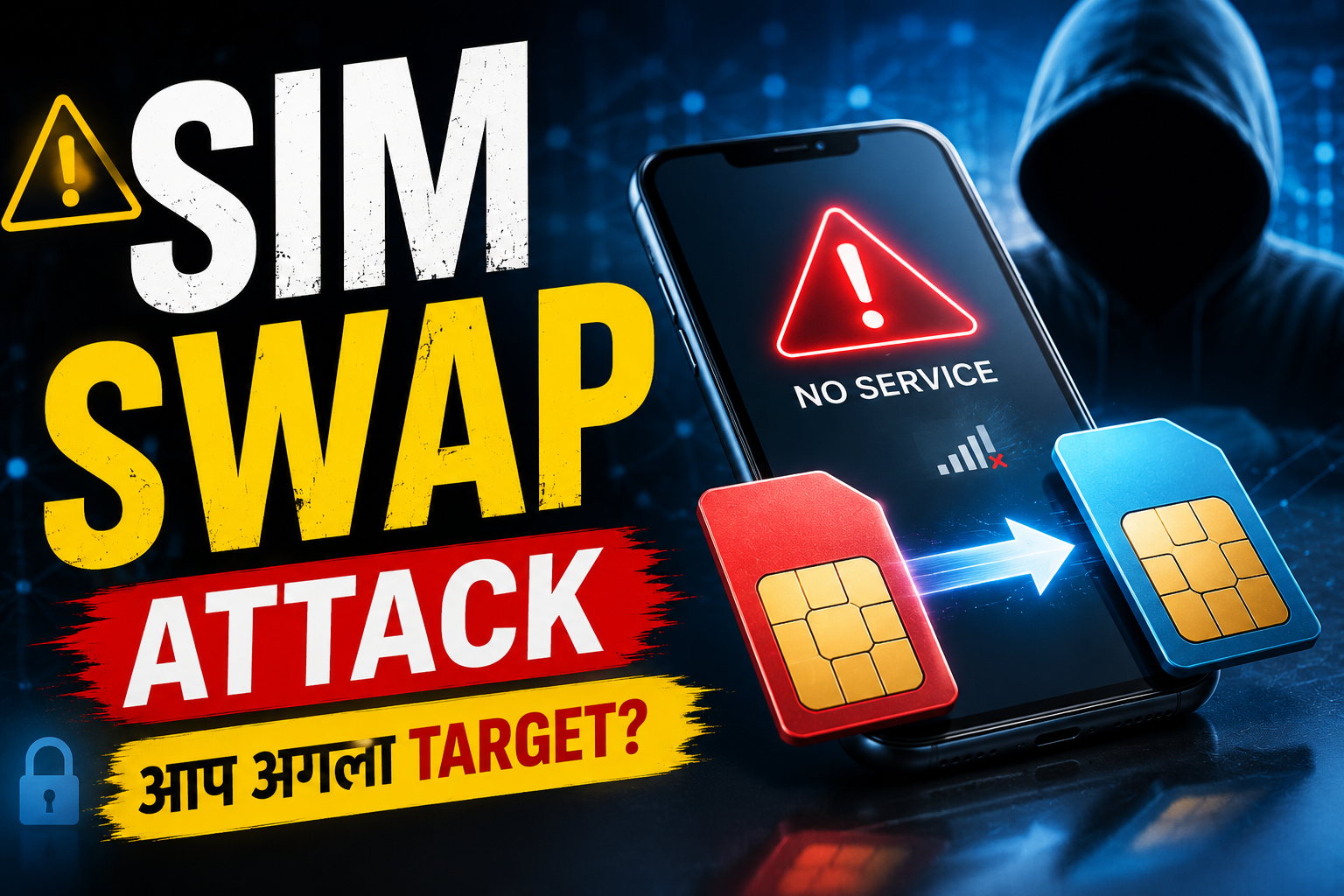
How SIM Swap Attacks Work
and How to Protect Yourself
📋 Table of Contents
- What is a SIM Swap Attack?
- How SIM Swap Attacks Actually Work
- Why SIM Swap is So Dangerous
- Real-World SIM Swap Cases
- Warning Signs You Are Being Targeted
- How Criminals Gather Your Personal Info
- How to Protect Yourself
- Telecom Security Gaps in India
- What to Do If You Are Attacked
- Future of SIM Security
1. What is a SIM Swap Attack?
A SIM Swap attack — also called SIM hijacking, SIM splitting, or SIM porting fraud — is a type of cyberattack where a criminal convinces your mobile network operator to transfer your phone number to a SIM card that the attacker controls. Once successful, every call and SMS meant for you is redirected to the attacker's phone.
This is particularly devastating because most people use their phone number as a second factor of authentication (2FA) for everything from banking to email to social media. The moment your number is hijacked, the attacker can request password resets, receive OTPs (One-Time Passwords), and completely take over your digital life — all within minutes.
SIM swapping is not a new attack vector, but it has grown explosively in recent years as more services rely on SMS-based OTPs as a security measure. What was once a niche fraud technique is now a mainstream cybercrime that targets everyone from average citizens to high-profile cryptocurrency investors and celebrities.
SMS-based OTP is the weakest form of two-factor authentication. A SIM swap completely bypasses it. If you rely on SMS OTP for your bank accounts, you are vulnerable.
2. How SIM Swap Attacks Actually Work
Understanding the mechanics of a SIM swap attack is the first step to defending against it. The attack typically unfolds in stages, each building on the last. Here is a detailed breakdown of the complete attack chain:
🔍 Reconnaissance
Attacker collects your personal info — name, DOB, address, last 4 digits of SSN/Aadhaar — from social media, data breaches, dark web, or phishing.
📞 Social Engineering
Attacker calls your telecom carrier's customer support, impersonates you, and requests a SIM transfer citing a "lost or damaged phone."
✅ Verification Bypass
Using the stolen personal info, the attacker passes identity verification questions asked by the telecom agent.
📱 SIM Activated
Carrier deactivates your SIM and activates a new one in the attacker's control with your phone number.
🔓 Account Takeover
Attacker requests password resets for your email, bank, crypto wallets. OTPs arrive on their phone. Accounts are compromised.
💸 Damage Inflicted
Money is transferred, accounts locked out, identities stolen. Victim often doesn't realize until hours later.
The Role of Insider Threats
Not all SIM swaps happen through social engineering alone. A particularly dangerous variant involves corrupt telecom employees or insiders who are directly bribed or coerced to perform unauthorized SIM swaps without any customer verification at all. This form of attack is near-impossible to detect in advance and leaves the carrier's security protocols completely useless.
In several documented cases in the US and UK, telecom employees were paid thousands of dollars per swap. These insiders had access to internal systems and could execute a SIM transfer in seconds with no questions asked.
Online SIM Porting — The Digital Variant
Many carriers now allow SIM swaps to be done online through an account portal or chat interface. Attackers who have already compromised your carrier account (perhaps through credential stuffing or phishing) can trigger a SIM port digitally without ever calling anyone. This automated variant is even faster and harder to detect.
In India, TRAI mandates a 7-day SIM porting wait period for mobile number portability (MNP) between operators. However, intra-operator SIM replacement (lost/damaged SIM reissue) can still happen within hours — and this is exactly what fraudsters exploit.
3. Why SIM Swap is So Dangerous
The severity of a SIM swap attack lies in how deeply our digital identity is tied to our phone numbers. Modern security systems treat a phone number as a trusted second factor of authentication. Once that trust is compromised, the entire security model collapses.
| Service Category | What Attacker Can Access | Potential Damage |
|---|---|---|
| Banking / Finance | Fund transfers, new payee addition, loan applications | Total financial loss |
| Email Accounts | Gmail, Outlook — all linked services reset via email | Identity takeover |
| Cryptocurrency | Exchange accounts, wallet recovery via phone | Irreversible crypto theft |
| Social Media | Instagram, WhatsApp, Facebook account recovery | Reputation, extortion |
| Government Services | DigiLocker, Aadhaar-linked services, EPFO | Identity fraud |
| Work Accounts | VPN, corporate email if phone = 2FA device | Corporate espionage |
The cascading effect is what makes SIM swap uniquely terrifying. Once the attacker controls your phone number, they gain access to your email. Once they control your email, they can reset almost every other account's password. This domino effect can destroy years of digital work in under an hour.
WhatsApp is particularly vulnerable. A SIM swap attacker can activate your WhatsApp on their device by receiving the SMS OTP. They can then impersonate you to your entire contact list and run scams like urgent money transfer requests from "your" account.
4. Real-World SIM Swap Cases
The Jack Dorsey Hack (2019)
Even Twitter's own CEO Jack Dorsey fell victim to a SIM swap attack. Hackers gained control of his phone number and posted offensive content from his official Twitter account for about 20 minutes before the attack was stopped. If the co-founder of a tech giant can be compromised, no one is immune.
The $5 Million Crypto Theft — Joel Ortiz
Joel Ortiz was a 20-year-old college student who conducted over 40 SIM swap attacks targeting cryptocurrency investors at a blockchain conference. He stole more than $5 million in cryptocurrency before being arrested. He received a 10-year prison sentence — one of the first major criminal convictions specifically for SIM swapping.
The T-Mobile Insider Breach (2023)
T-Mobile experienced multiple data breaches and SIM swap incidents where customer data was leaked including names, DOBs, SSNs, and driver's license numbers. This data then fueled a second wave of SIM swap attacks as fraudsters used the leaked PII to impersonate victims at carrier stores.
India: SIM Swap Fraud in Banking
India has seen a significant rise in SIM swap fraud targeting bank customers. The typical modus operandi involves fraudsters calling victims claiming to be telecom operators and asking them to share their 20-digit SIM number (printed on the SIM card). Once obtained, they visit a telecom outlet and fraudulently issue a new SIM. Victims notice their phone suddenly shows "No Service" and within hours their bank accounts are drained via unauthorized UPI or NEFT transactions.
The common thread across all real-world cases: the attacker had enough personal information (PII) to pass identity verification. The solution starts with controlling what personal data you expose publicly online.
5. Warning Signs You Are Being Targeted
Recognizing a SIM swap early can mean the difference between a close call and a complete disaster. Your window of action is extremely narrow — sometimes just minutes. Here are the warning signs at every stage:
Early Warning Signs (Before the Swap)
- Unusual calls or texts claiming to be from your telecom provider asking you to confirm account details
- Unexpected OTPs arriving on your phone that you did not request (attacker is testing your number)
- Someone trying to log in to your accounts from unknown locations (visible in account security dashboards)
- Strange social media messages asking about your phone carrier or asking personal questions
- Your personal data appearing in breach databases (check HaveIBeenPwned)
Immediate Warning Signs (During the Swap)
- Phone suddenly shows "No Service" or "SOS Only" — this is the most critical alert
- You cannot make or receive calls despite being in an area with good signal
- Your carrier's app logs you out or says your account information is incorrect
- Family or contacts report they cannot reach you
Post-Swap Warning Signs (Aftermath)
- Password reset emails arriving in your inbox that you did not request
- Notifications of logins from unfamiliar devices or locations
- Bank alert messages for transactions you did not make
- Friends reporting your WhatsApp or social media is sending weird messages
- Your email password suddenly doesn't work
If your phone suddenly loses all network signal unexpectedly, immediately call your carrier from a different phone or find WiFi and use their app. Do not wait to "see if it comes back." Every second counts.
6. How Criminals Gather Your Personal Information
For a SIM swap to succeed, the attacker needs enough personal identifying information (PII) to impersonate you. Understanding how they get this data helps you plug the leaks:
Data Breach Databases
Billions of records from data breaches at companies like Adobe, LinkedIn, Facebook, and hundreds of others are freely available on dark web forums. Your email, password, phone number, date of birth, and sometimes even security question answers may already be out there. Attackers cross-reference multiple breach databases to build a complete profile of a target.
Social Media OSINT (Open Source Intelligence)
Your public Facebook or Instagram profile may contain your birthday, hometown, school, workplace, and even your phone number. Profile photos at home reveal your address area. Posts about anniversaries reveal important dates. All of this becomes ammunition. Attackers spend time doing social media research — called OSINT — before executing attacks.
Phishing Attacks
Attackers send convincing phishing SMS or emails pretending to be your bank, telecom provider, or a courier service. The fake page asks you to enter your details to "verify your identity" or "track your parcel." Every detail you enter goes directly to the attacker.
Vishing (Voice Phishing)
Some attackers call victims directly, pretending to be from the telecom company's customer service. They claim there is a network issue and ask you to share your SIM number, account number, or confirm personal details. Victims who cooperate unknowingly hand over everything needed for a SIM swap.
| Data Source | Information Obtained | How to Mitigate |
|---|---|---|
| Social Media | DOB, hometown, contacts, photos | Set profiles to private, remove DOB |
| Data Breaches | Email, password, phone, address | Use HaveIBeenPwned, change passwords |
| Phishing Sites | Login credentials, PAN, Aadhaar | Never click suspicious links |
| Vishing Calls | SIM number, account PIN, OTPs | Never share OTP or SIM details on call |
| Dark Web Purchase | Full identity packages (name+DOB+PAN) | Use credit monitoring services |
7. How to Protect Yourself from SIM Swap Attacks
The good news is that SIM swap attacks are highly preventable if you implement the right safeguards. Here is a comprehensive protection strategy arranged from most to least impactful:
🔐 Level 1 — Telecom-Level Protection (Most Critical)
- Call your telecom carrier and set a SIM lock PIN or port freeze — a separate PIN required before any SIM changes can be made on your account
- For Airtel users: Enable Airtel Thanks app SIM lock feature. For Jio: set account security PIN via MyJio app
- Request your carrier to add a note that SIM swaps require in-store ID verification only — no remote changes allowed
- Avoid sharing your 20-digit SIM card number with anyone over the phone
- If you receive any call from "your telecom" asking for SIM details, hang up and call the official number yourself
📱 Level 2 — Move Away from SMS 2FA
- Switch from SMS OTP to an authenticator app (Google Authenticator, Authy, Microsoft Authenticator) for all critical accounts
- Use hardware security keys (YubiKey) for your most sensitive accounts like Google, GitHub
- For banking: prefer in-app OTPs or transaction passwords over SMS wherever available
- Enable email-based 2FA rather than SMS 2FA when both options are available
- Register a backup authenticator so you're not locked out if your device is lost
🔑 Level 3 — Account Security Hardening
- Use a unique, strong password for every account — use a password manager (Bitwarden, 1Password)
- Enable login notification alerts on all critical accounts (email, bank, social media)
- Set up account recovery options that do not rely on your phone number (backup email, recovery codes)
- Regularly check your Google account's "Security Checkup" and Apple ID security settings
- For Google accounts, enroll in the Advanced Protection Program
🕵️ Level 4 — Reducing Your Attack Surface
- Remove your phone number from social media profiles (Instagram, Facebook, LinkedIn)
- Do not publicly share your date of birth on social media
- Check your email on haveibeenpwned.com to see if your data has been breached
- Use a separate email address for banking — one you never use for sign-ups or newsletters
- Be extremely cautious about what you share in WhatsApp groups — personal details spread fast
Multi-layer protection architecture — each layer adds an independent barrier
8. Telecom Security Gaps in India
India's telecom landscape presents unique challenges when it comes to SIM swap fraud prevention. Despite TRAI guidelines and growing awareness, structural vulnerabilities persist:
The Retailer Problem
India has hundreds of thousands of micro-retailer SIM dealers across rural and urban areas. While major cities may have stricter verification protocols, smaller towns and villages often have outlets where documentation requirements are lax, staff are inadequately trained, and verification is minimal. Fraudsters exploit these weaker links in the chain.
Biometric Aadhaar Verification
TRAI mandated Aadhaar-based biometric authentication for new SIM activations to counter fraud. This was a significant step forward. However, SIM replacement (not new activation) for existing numbers often falls through procedural gaps where full biometric re-verification is not consistently enforced.
The Jio-Airtel-BSNL Asymmetry
Different carriers have very different security protocols for account changes. Jio's digital-first approach means most changes happen via the MyJio app with reasonably good authentication. However, BSNL's older infrastructure and fragmented customer service creates inconsistent security practices. Attackers research which carrier is weakest before targeting victims.
The 7-Day MNP Window — A Double-Edged Sword
The 7-day waiting period for Mobile Number Portability between operators gives victims time to detect and stop unauthorized ports. However, attackers bypass this entirely by doing intra-operator SIM replacements (claiming lost/damaged SIM to the same operator), which can be processed same-day.
TRAI's regulation requires carriers to send an SMS notification when a SIM replacement is done on your number. If you receive such an SMS, immediately call 1800-xxx-xxxx (your carrier's fraud line) and report the unauthorized change.
9. What to Do If You Are Attacked
If you suspect a SIM swap has already occurred, speed is everything. Here is the exact sequence of actions to minimize damage:
📞 Call Carrier Immediately
From someone else's phone, call your carrier's fraud line. Report unauthorized SIM change and request your number be suspended and restored.
🏦 Block Bank Accounts
Call your bank immediately. Request a temporary block on all outgoing transactions. Change net banking password and mobile PIN from a desktop computer on a secure network.
📧 Secure Email First
On WiFi (without needing your SIM), change your email account password. Revoke all active sessions. This stops the cascade since most resets go via email.
🔄 Reset Critical Accounts
Change passwords for banking, crypto, social media. Use backup codes if available. Enable authenticator app instead of SMS 2FA wherever possible.
📋 File a Complaint
File cybercrime complaint at cybercrime.gov.in or call 1930 (Cyber Fraud Helpline). Also file an FIR at local police station — required for bank refund claims.
📝 Document Everything
Screenshot all suspicious logins, transactions, and messages. Keep records of times, amounts, and account details. This is critical for recovery and insurance claims.
Bank Fraud Recovery in India
If your bank account is drained due to a SIM swap and unauthorized transactions, the RBI circular on customer liability provides some protection. If you report the fraud within 3 working days of receiving the transaction notification, and it occurred through no negligence on your part, you may be entitled to a full refund. The timeline for reporting is critical — do not delay.
10. The Future of SIM Security
The telecommunications and cybersecurity industries are not standing still. Several emerging solutions aim to significantly reduce or eliminate SIM swap vulnerabilities:
eSIM Technology
Embedded SIMs (eSIMs) are built into the device and cannot be physically swapped. While eSIM profiles can technically still be transferred, the process is more rigorously controlled and typically requires authentication through the carrier's app with biometric verification. As eSIM adoption grows in India (already standard in iPhone 14+ and many Android flagships), the physical SIM swap vector diminishes.
STIR/SHAKEN Protocol
This US-originated framework for authenticating caller ID is being adopted globally. It makes it harder for attackers to spoof telecom company numbers when calling victims or even when calling carrier support lines pretending to be the victim.
Behavioral Biometrics
Banks and telecom companies are increasingly using AI-based behavioral biometrics — analyzing how you type, swipe, and interact with your device — as an additional continuous authentication layer that cannot be bypassed with just a SIM swap.
FIDO2 and Passkeys
The FIDO2 standard and passkeys (supported by Apple, Google, and Microsoft) replace passwords and SMS OTPs entirely with device-bound cryptographic keys. A SIM swap becomes completely irrelevant when authentication is tied to your device's hardware security chip rather than your phone number.
Don't wait for better technology. The most impactful thing you can do right now: (1) Call your carrier and set a SIM lock PIN. (2) Install Google Authenticator and switch your bank's 2FA to it if possible. (3) Check haveibeenpwned.com for your email. These three steps dramatically reduce your risk.