 Tyagi
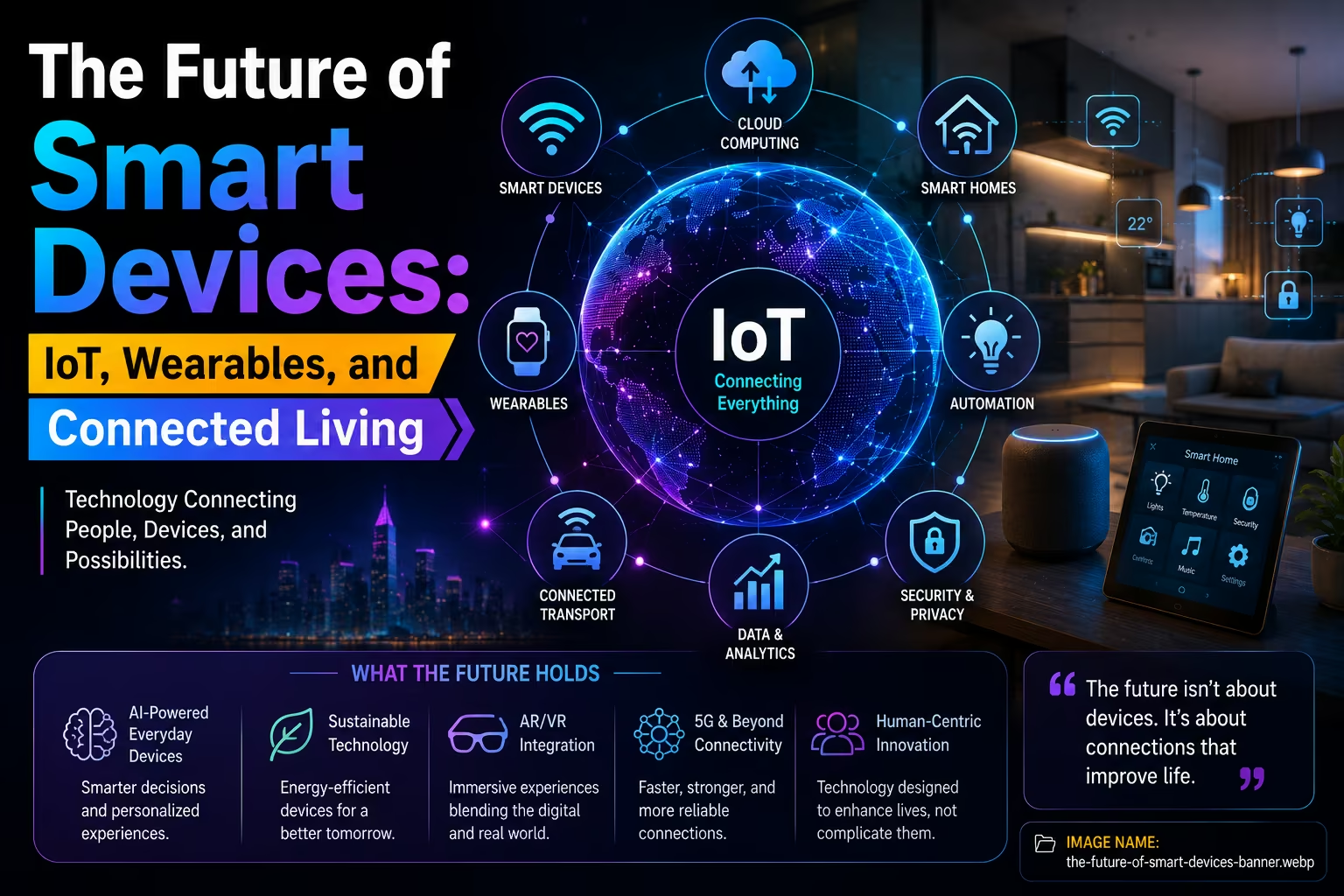
TyagiThe Future of Smart Devices: IoT, Wearables, and Connected Living
Explore how smart devices, IoT ecosystems, wearable tech, and connected homes are evolving — and what the fully connected future looks like for Indian households.
- 1. The Internet of Things — Where We Are Now
- 2. Wearable Technology Evolution
- 3. Smart Home Ecosystem
- 4. 5G's Role in the Smart Device Revolution
- 5. Edge AI — Intelligence at the Device Level
- 6. Smart Cities and Urban IoT
- 7. Smart Devices Landscape in India
- 8. IoT Security — The Hidden Danger
- 9. Devices of the Near Future
- 10. Smart Device Buying Guide for Indian Consumers
1. The Internet of Things — Where We Are Now
The Internet of Things (IoT) refers to the vast network of physical devices, vehicles, appliances, and other items embedded with sensors, software, and connectivity that enables them to connect and exchange data. We have moved from a world where only computers and phones were connected to one where billions of everyday objects — from refrigerators to streetlights to industrial machinery — are part of the internet.
In 2026, there are estimated to be over 18 billion connected IoT devices worldwide, and this number is projected to exceed 30 billion by 2030. The applications span from consumer electronics in your home to industrial sensors in factories, agricultural monitors in fields, medical devices in hospitals, and infrastructure sensors in cities.
What makes the current moment particularly significant is the convergence of several technologies: cheaper sensors, faster wireless connectivity (5G), more powerful edge computing chips, and AI algorithms that can make sense of the massive data streams these devices generate. This convergence is transforming IoT from an interesting technology into genuinely transformative infrastructure.
2. Wearable Technology Evolution
Wearable technology has undergone a remarkable transformation. Early fitness bands simply counted steps. Today's wearables are sophisticated health monitoring platforms that would have been considered medical-grade technology just five years ago.
Smartwatches
ECG monitoring, blood oxygen measurement, skin temperature sensing, sleep apnea detection, stress monitoring via HRV, menstrual cycle tracking, and even blood glucose estimation (emerging) in premium models.
Smart Earbuds
Beyond audio: real-time language translation, heart rate monitoring via in-ear sensors, hearing aid functionality, spatial audio, active noise cancellation that adapts to environment, and head gesture controls.
Smart Glasses
AR overlays, hands-free AI assistance, camera for POV recording, navigation overlays, real-time translation of text in your field of view. Meta Ray-Bans and similar are now mainstream.
Smart Rings
Ultra-compact health monitors on your finger: sleep tracking, HRV, skin temperature, SpO2, activity tracking — without the bulk of a watch. Oura Ring and Samsung Galaxy Ring are leading this category.
Medical Wearables
Continuous glucose monitors (CGM) for diabetics, ECG patches worn for days to detect arrhythmias, smart insulin pens, wearable blood pressure monitors — clinical-grade moving to consumer market.
Smart Textiles
Clothing with embedded sensors monitoring posture, muscle activity, breathing rate, and thermal comfort. Primarily in sports performance and healthcare rehabilitation currently.
Wearables in India: A Booming Market
India became the world's second-largest market for wearable devices in 2024. Brands like Noise, boAt, Fire-Boltt, and Amazfit have made smartwatches with health monitoring features accessible at ₹2,000-₹5,000 price points — dramatically lower than global brands. This democratization means health monitoring technology that cost lakhs of rupees in hospital settings a decade ago is now on the wrists of college students in tier-2 cities.
3. Smart Home Ecosystem
The smart home is evolving from a collection of individually clever gadgets into a genuinely integrated, intelligent living environment. The key shift is from manual control ("Hey Google, turn off the lights") to autonomous intelligence ("The home knows you've gone to sleep and adjusts lighting, temperature, and security accordingly without being asked").
Smart Home Device Categories
| Category | Examples | Key Capability |
|---|---|---|
| Smart Speakers / Hubs | Echo, Google Nest Hub, HomePod | Voice control, routine orchestration, home management |
| Smart Lighting | Philips Hue, Syska Smart, TP-Link Tapo | Mood lighting, schedules, energy optimization |
| Smart Security | Ring, Arlo, Mi Smart Camera | AI-powered motion detection, person/package recognition |
| Smart Climate | Nest Thermostat, Daikin Smart AC | Learning your preferences, energy savings, remote control |
| Smart Appliances | Samsung Family Hub fridge, LG ThinQ | Remote monitoring, inventory management, diagnostics |
| Smart Plugs/Switches | Wipro, Orient, TP-Link | Remote control of any appliance, energy monitoring |
| Smart Door Locks | Yale, Godrej, Dormakaba | Keyless entry, temporary access codes, access logs |
Matter Protocol — The Universal Standard
One of the most important developments in smart home technology is the widespread adoption of the Matter protocol, a universal smart home standard backed by Apple, Google, Amazon, Samsung, and over 550 companies. Matter allows devices from different manufacturers to work seamlessly together without proprietary bridges or workarounds. This is solving the previously frustrating fragmentation of smart home ecosystems.
4. 5G's Role in the Smart Device Revolution
5G is not just faster internet for smartphones — it is the infrastructure backbone that makes truly massive IoT deployment possible. Its combination of high bandwidth, ultra-low latency, and the ability to support massive numbers of simultaneous connections per square kilometer is purpose-built for IoT at scale.
Why 5G Changes IoT Fundamentally
- Ultra-Low Latency (1ms): Enables real-time applications like autonomous vehicle coordination, remote surgery, and industrial robot control that require instant response
- Massive Device Density: 5G can support up to 1 million devices per square kilometer — enabling city-scale IoT deployments
- Network Slicing: Creates virtual dedicated networks for different IoT use cases with different priority and latency requirements
- 5G mmWave for Industrial IoT: Ultra-high bandwidth for data-intensive industrial applications like real-time 4K video monitoring of production lines
5G IoT in India
India's 5G rollout by Jio and Airtel has reached over 700 cities by mid-2026. While consumer 5G is already widespread, the enterprise and IoT applications of 5G are now beginning to scale. Jio's private 5G network deployments in factories, ports, and warehouses, along with smart city 5G pilots in Gurugram, Bengaluru, and Hyderabad, represent the early stages of India's 5G IoT ecosystem.
5. Edge AI — Intelligence at the Device Level
Edge AI refers to running AI algorithms directly on the device (the "edge") rather than sending data to the cloud for processing. This is one of the most significant trends shaping the future of smart devices.
Why Edge AI Matters
- Privacy: Your data doesn't leave the device — voice commands processed locally never reach company servers
- Speed: No round-trip to the cloud means instant response, critical for safety-related features
- Reliability: Functions without internet connection — smart home devices work even when cloud servers are down
- Reduced Bandwidth: Only useful processed information is sent to cloud rather than raw sensor data
Apple's Neural Engine in iPhone chips, Google's Tensor chip in Pixels, Qualcomm's Hexagon AI processor in Android flagships, and dedicated AI chips from MediaTek are all examples of edge AI hardware becoming standard in consumer devices. The next frontier is bringing comparable AI processing power to much smaller form factors — smartwatches, earbuds, and eventually smart glasses and rings.
6. Smart Cities and Urban IoT
Smart cities represent the largest-scale application of IoT technology — applying sensor networks, data analytics, and AI to optimize how cities function and how they serve their residents:
Key Smart City IoT Applications
- Smart Traffic Management: AI-powered traffic lights that adapt in real-time to traffic flow, reducing congestion and emissions
- Smart Street Lighting: LED streetlights with motion sensors that brighten only when pedestrians are present, saving enormous energy
- Smart Waste Management: Sensor-equipped garbage bins that signal when full, enabling efficient collection routing
- Air Quality Monitoring: Dense sensor networks measuring PM2.5, PM10, NO2, and other pollutants at neighborhood level
- Smart Parking: Sensors in parking spaces that feed real-time availability to an app, eliminating circling
- Water Leak Detection: Smart sensors in water pipes detecting pressure anomalies that indicate leaks before they become visible
India's Smart Cities Mission
India's Smart Cities Mission has designated 100 cities for smart infrastructure development. Cities like Surat, Pune, Ahmedabad, and Indore have deployed integrated command and control centers that aggregate data from thousands of IoT sensors across the city, enabling real-time monitoring and response. These systems have demonstrated measurable improvements in traffic management, water conservation, and emergency response times.
7. Smart Devices Landscape in India
India-Specific Challenges and Solutions
India's smart device market operates in a unique context: electricity supply that can be intermittent in many areas, extreme climate diversity (from -20°C in Ladakh to 45°C in Rajasthan), patchy internet connectivity outside major cities, price sensitivity, and multiple languages requiring voice assistant support.
Indian companies and global brands operating in India have adapted. Devices are being designed for harsher environmental conditions. Voice assistants now support Hindi, Tamil, Telugu, Bengali, and other Indian languages. Budget smart home ecosystems from brands like Wipro, Orient, Syska, and TP-Link Tapo offer entry points at a fraction of Western market prices.
Government Initiatives
The Indian government's push for Digital India, Smart Cities Mission, and Manufacturing in India is creating significant tailwinds for smart device adoption. The Production Linked Incentive (PLI) scheme for electronics manufacturing is incentivizing companies to manufacture smart devices domestically rather than importing them, which should bring prices down further.
For Indian consumers, the sweet spot for smart home entry is starting with smart plugs (₹600-₹1,500) — they convert any existing appliance into a smart-controlled one without replacing expensive devices. Combine with a free Google Home or Amazon Alexa app setup and you have a functional smart home ecosystem at minimal cost.
8. IoT Security — The Hidden Danger
The rapid proliferation of IoT devices has created an enormous and largely unprotected attack surface for cybercriminals. IoT security is one of the most serious and underappreciated cybersecurity challenges today.
Why IoT Devices Are Insecure
- Many devices ship with default passwords (admin/admin) that users never change
- Budget devices often never receive security updates after manufacture
- Low-power constraint on many sensors prevents running proper encryption
- Devices often run ancient Linux kernels with known unpatched vulnerabilities
- Users don't think of their smart bulb or thermostat as a computer that can be hacked
The Risks Are Real
Compromised IoT devices are recruited into botnets for DDoS attacks. Smart home devices can be used to spy on occupants. Vulnerable medical IoT devices could theoretically be manipulated to harm patients. Industrial IoT attacks can shut down factories or damage equipment. Baby monitors and home cameras have repeatedly been found accessible online with no authentication required.
Change default passwords on every device immediately. Keep firmware updated. Put IoT devices on a separate Wi-Fi network (guest network) isolated from your main computers and phones. Disable UPnP on your router. Regularly audit what's connected to your network using your router's device list.
9. Devices of the Near Future
Neural Interface Devices
Brain-computer interfaces like Neuralink are in early clinical trials. Near-term applications focus on restoring movement for paralysis patients, but longer-term consumer applications for thought-to-text and AR control are being explored.
Smart Contact Lenses
Samsung and Mojo Vision are developing contact lenses with embedded micro-displays for AR overlays. Early prototypes exist; consumer availability likely 2028-2030.
Non-Invasive Glucose Monitors
Accurate blood glucose monitoring without finger pricks via smartwatch optical sensors. Several companies racing to crack this for the massive diabetes management market.
Ambient Computing
AI embedded in every surface of your environment — walls, mirrors, tables — that responds to your presence and needs without explicit interaction. The phone-less future.
10. Smart Device Buying Guide for Indian Consumers
| Category | Budget Pick (Indian Brand) | Premium Pick | Key Feature to Check |
|---|---|---|---|
| Smartwatch | Noise ColorFit Pro (₹2,500) | Apple Watch / Samsung Galaxy Watch | Health sensors accuracy, battery life |
| Smart Speaker | Amazon Echo Dot (₹3,499) | Google Nest Audio / Echo Studio | Hindi language support |
| Smart Bulb | Wipro Garnet (₹499) | Philips Hue (₹2,000+) | Matter/Thread support for future-proofing |
| Smart Camera | Mi 360° Camera (₹1,500) | Arlo Pro 4 / Ring | Local storage option (privacy) |
| Smart Plug | TP-Link Tapo P100 (₹699) | Eve Energy (₹3,500) | Energy monitoring feature |
| Smart Lock | Godrej Advantis (₹8,000) | Yale Assure 2 / Schlage | Manual key backup + app + fingerprint |
Choose one ecosystem (Google Home or Amazon Alexa) and stick to it — mixing ecosystems creates compatibility headaches. For future-proofing, prioritize devices that support the Matter standard, which allows cross-ecosystem compatibility.
Discussion & Reviews
Tap stars to rate this page: