 Tyagi
Tyagi
What is Edge Computing? How It Works and Why It Matters
Understand edge computing — what it is, how it differs from cloud computing, real-world applications in telecom, manufacturing, healthcare, and why 5G makes it critical.
- 1. What is Edge Computing?
- 2. Edge vs Cloud vs Fog Computing
- 3. How Edge Computing Works
- 4. Why Latency Matters — The Core Problem Edge Solves
- 5. Real-World Use Cases
- 6. 5G and Multi-Access Edge Computing (MEC)
- 7. Key Players in Edge Computing
- 8. Edge Computing in India
- 9. Challenges and Limitations
- 10. The Future of Edge Computing
1. What is Edge Computing?
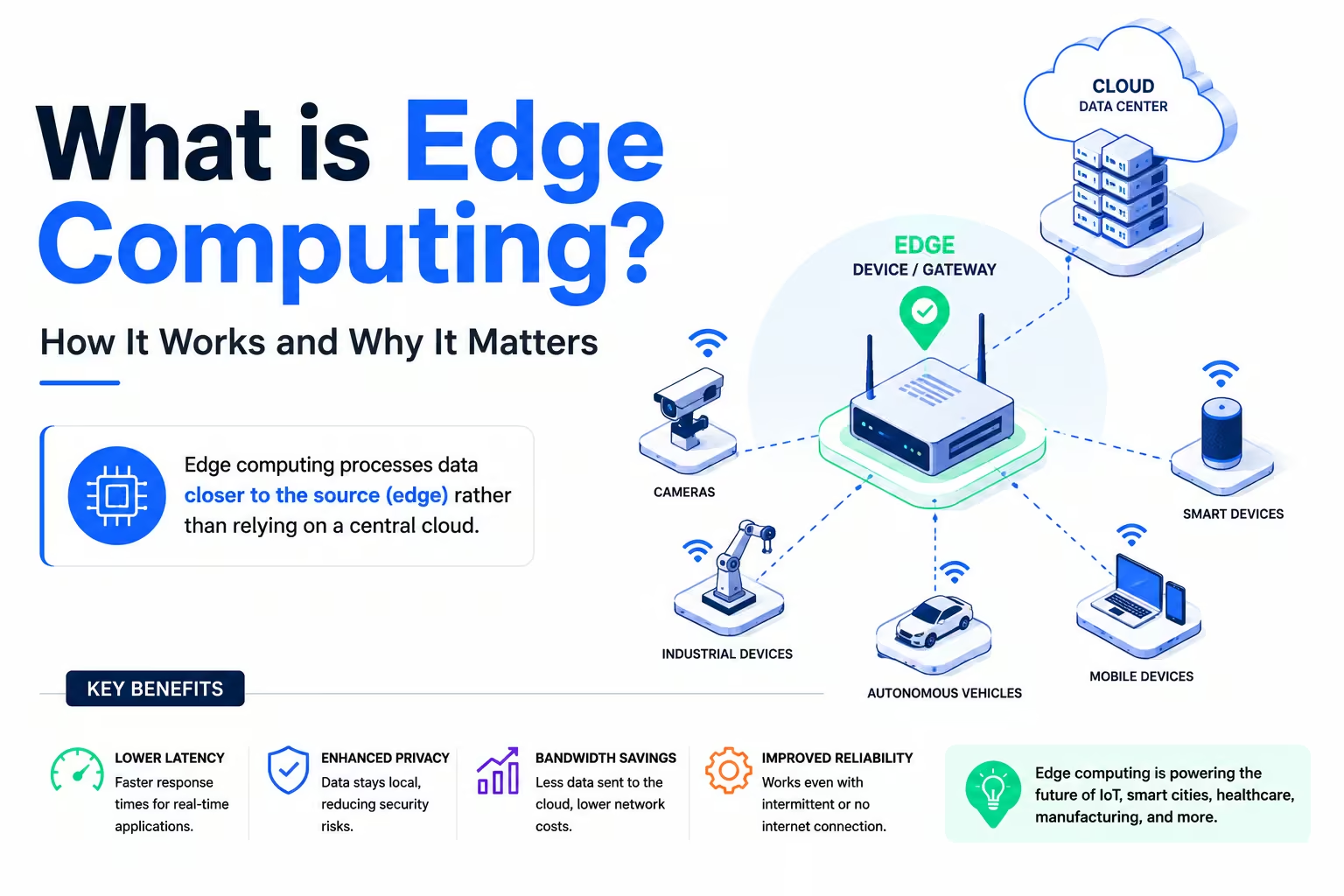
Edge computing is a distributed computing paradigm that brings computation and data storage closer to the sources of data, rather than relying on a centralized data center that may be thousands of kilometers away. The "edge" refers to the geographic edge of the network — the location closest to where data is being generated and consumed.
To understand why this matters, consider a simple analogy. Imagine you need to ask a question to an expert. You could write a letter to an expert in Mumbai (the cloud) and wait for a reply that takes days (high latency). Or you could ask a local expert in your city (the edge) and get an answer in seconds. Edge computing is about placing computing power at that "local expert" position — close to where you need it.
The explosion of IoT devices, autonomous systems, real-time analytics requirements, and AI inference at the device level has made edge computing not just a niche optimization but a critical infrastructure requirement for the next generation of applications.
2. Edge vs Cloud vs Fog Computing
These three terms describe points along a spectrum of where computation happens relative to the data source:
| Model | Where Processing Happens | Latency | Best For |
|---|---|---|---|
| Cloud Computing | Centralized data centers (Mumbai, Singapore, US) | 50-300ms | Large-scale batch processing, storage, non-real-time AI training |
| Fog Computing | Local network layer — gateways, routers, local servers | 10-50ms | Smart building automation, local network management |
| Edge Computing | At or near the device / data source (base stations, local servers) | 1-10ms | Autonomous vehicles, real-time industrial control, AR/VR |
| On-Device (Embedded) | Inside the device itself | <1ms | Facial recognition unlock, voice wake word, real-time safety features |
Cloud computing centralizes everything for efficiency. Edge computing distributes processing for speed. Most real-world architectures combine both — edge handles time-critical local processing, cloud handles historical analysis, AI model training, and centralized management. They are complementary, not competing.
3. How Edge Computing Works
The Architecture
An edge computing architecture typically consists of three layers working together:
- Device Layer: IoT sensors, cameras, machines, vehicles — the data generators. Increasingly, these devices have some on-board processing capability themselves.
- Edge Layer: Small to medium servers deployed at base stations, factory floors, retail stores, hospitals, or vehicles. These run real-time processing, AI inference, and local data analysis. They may be edge servers from telecom operators, micro data centers, or ruggedized industrial servers.
- Cloud Layer: Traditional centralized cloud for aggregate analysis, long-term storage, model training, coordination, and non-time-sensitive operations.
Data Flow Example: Autonomous Vehicle
A self-driving car generates terabytes of sensor data per hour from cameras, LiDAR, radar, and ultrasonic sensors. Processing this data in the cloud would require uploading terabytes over a cellular connection with 50-200ms latency — completely impractical for real-time collision avoidance decisions that require millisecond response. Edge computing here means running the perception and decision AI entirely on powerful computers inside the vehicle itself (on-device edge), while only sending summary data and learning updates to the cloud.
4. Why Latency Matters — The Core Problem Edge Solves
The fundamental limitation that edge computing addresses is latency — the time delay between a request and a response. While 100 milliseconds sounds imperceptibly small to a human, it is an eternity for many modern systems:
Autonomous Vehicles
At 100 km/h, a car travels 2.8 meters in 100ms. Cloud latency is unacceptable for collision avoidance decisions — edge or on-device processing is mandatory.
Industrial Control
Robotic arms on assembly lines may need microsecond-precision control loops. Even 10ms cloud latency would make precise control impossible.
Cloud Gaming / VR
VR requires frame rendering at <20ms to avoid motion sickness. Cloud gaming benefits enormously from edge servers in the same city as players.
Remote Surgery
A surgeon operating a robotic system remotely cannot tolerate 200ms delays — hand movements and visual feedback must be near-instantaneous.
Video Analytics
A security camera network sending all video to cloud would require enormous bandwidth. Edge processing analyzes video locally, only sending alerts or highlights.
Real-time Fraud Detection
Payment fraud detection needs to approve or reject transactions in milliseconds at point of sale. Edge inference enables this at retail scale.
5. Real-World Use Cases
Retail: Amazon Go and Smart Stores
Amazon Go cashierless stores use hundreds of cameras and sensors with edge AI processing to track what items shoppers pick up and automatically charge them when they leave. The data volume from all those cameras (4K video streams) cannot be sent to cloud in real-time — edge servers in the store run the computer vision algorithms locally.
Healthcare: ICU Monitoring
Modern ICUs generate continuous data from patient monitors, ventilators, infusion pumps, and vital sign sensors. Edge computing in hospital networks allows AI to analyze these streams in real-time and alert staff to deteriorating patient conditions seconds before they become crises — without sending sensitive patient data over the public internet to a cloud provider.
Manufacturing: Predictive Maintenance
Industrial machines generate vibration, temperature, power consumption, and acoustic data that AI can use to predict failures before they happen. Edge servers on the factory floor analyze these sensor streams in real-time, enabling maintenance teams to service equipment during scheduled downtime rather than after catastrophic failure.
Telecom: Content Delivery Networks (CDN)
This is the oldest and most mature form of edge computing. Netflix, YouTube, and Hotstar place content caches at edge locations near population centers. When you stream a movie, you're actually streaming from a server potentially a few kilometers away, not a data center halfway around the world — which is why streaming quality is far better than what the physics of long-distance internet would otherwise allow.
6. 5G and Multi-Access Edge Computing (MEC)
5G and edge computing are deeply intertwined. Multi-Access Edge Computing (MEC), standardized by ETSI, places compute infrastructure directly inside 5G base stations and at the radio access network (RAN) edge. This co-location of computing and wireless connectivity creates a new category of ultra-low-latency, high-bandwidth services.
What MEC Enables
- Network Slicing: Dedicated virtual network segments with guaranteed performance characteristics for specific applications (e.g., a guaranteed 1ms slice for factory robotics)
- Local Breakout: Traffic destined for local services never leaves the local network, drastically reducing latency and improving privacy
- Location-Aware Services: Precise real-time location from the network itself (without GPS) enables new location-based services
- Cloudlet Services: Small cloud-like environments at the edge that mobile apps can offload computation to
In India, Jio and Airtel's 5G deployments are beginning to incorporate MEC capabilities, initially targeted at enterprise and industrial customers. Jio's private 5G network in Reliance's own facilities in Jamnagar is one of India's most advanced early deployments of 5G MEC for industrial automation.
7. Key Players in Edge Computing
| Company | Edge Offering | Key Differentiator |
|---|---|---|
| AWS | AWS Outposts, AWS Wavelength, AWS Local Zones | Extend AWS infrastructure to on-premises and telecom networks |
| Microsoft Azure | Azure Stack Edge, Azure Arc | Hybrid management, strong enterprise integration |
| Google Cloud | Google Distributed Cloud, Anthos | Kubernetes-native, strong AI/ML at edge |
| Cloudflare | Cloudflare Workers (edge serverless) | 300+ global edge locations, developer-friendly |
| NVIDIA | Jetson edge AI modules, EGX platform | GPU-accelerated AI inference at the edge |
| Qualcomm | Snapdragon Edge AI platform | AI in mobile and IoT chipsets |
| Jio Platforms | JioCloud Edge, Private 5G MEC | India-specific edge for Jio's massive infrastructure |
8. Edge Computing in India
India presents a particularly compelling case for edge computing investment. With 750M+ internet users, rapidly growing video consumption, expanding smart city deployments, rising industrial automation, and aggressive 5G rollout, the demand drivers are all accelerating simultaneously.
Key Indian Edge Computing Deployments
- BFSI Sector: Banks deploying edge servers at ATM clusters for local fraud detection, reducing network dependency and improving response times for ATM transactions
- Manufacturing (Industry 4.0): Auto manufacturers in Pune and Chennai implementing edge AI for quality control vision systems on production lines
- Retail: Large format retailers using edge-powered computer vision for inventory management and footfall analytics without cloud connectivity requirements
- Agriculture: AgriTech startups deploying edge-capable drones and ground sensors in farms where cloud connectivity is absent but local processing is still needed
- Smart Cities: Traffic management systems in Bengaluru, Hyderabad, and Pune using edge servers at intersections for real-time adaptive signal control
Edge computing is especially valuable in India where internet connectivity, while improving rapidly, is still unreliable in many regions. Processing data locally at the edge ensures systems continue to function during internet outages — a critical requirement for industrial, healthcare, and agricultural applications in tier-2 and tier-3 India.
9. Challenges and Limitations
- Physical Security: Edge hardware deployed in factories, retail stores, or on streetlights is far more vulnerable to physical theft or tampering than heavily secured central data centers
- Management Complexity: Managing thousands of distributed edge nodes vs a few centralized cloud regions is vastly more complex — requiring sophisticated orchestration tools like Kubernetes Edge
- Limited Capacity: Edge nodes have constrained compute, memory, and storage compared to cloud — not suitable for large-scale AI training or massive data storage
- Update and Maintenance: Pushing software updates and maintaining hardware across thousands of distributed locations is operationally challenging and expensive
- Standardization: The edge computing landscape is fragmented with competing standards, hardware platforms, and management frameworks
- Cost per compute unit: Edge compute is more expensive per unit than cloud due to smaller scale economies and physical infrastructure requirements
10. The Future of Edge Computing
Edge computing is moving from a specialized solution for specific use cases toward a fundamental layer of computing infrastructure. Several trends are shaping its evolution:
AI Inference at the Edge
As AI models become more important for every application, the ability to run AI inference at the edge (rather than sending data to cloud AI services) becomes critical. Advances in model compression, quantization, and edge AI chips (NPUs, tensor processing units) are making this increasingly feasible at low cost and power consumption.
Edge-Native Applications
A new generation of applications being designed specifically for edge-native architectures — rather than adapting cloud apps for the edge — will unlock use cases that simply weren't possible before: truly autonomous systems, ultra-immersive AR/VR, ambient computing environments that respond instantly to human presence.
Serverless Edge
Platforms like Cloudflare Workers and AWS Lambda@Edge are making it possible to deploy code to hundreds of edge locations worldwide without managing any infrastructure — democratizing edge computing for individual developers and small companies.
Edge computing is not replacing cloud computing — it is completing it. Cloud handles scale, storage, and training. Edge handles speed, privacy, and reliability. Together, this cloud-to-edge continuum is the computing architecture that will power the next decade of innovation, from smart cities to autonomous systems to immersive digital experiences.
Discussion & Reviews
Tap stars to rate this page: