
The very first action most professionals take upon opening their eyes in the morning is reaching for their glowing smartphone on the nightstand. Within sixty seconds of consciousness, their brain is inundated with angry client emails, urgent WhatsApp group pings, Instagram algorithm reels, breaking political controversies, and bank balance alerts.
By subjecting your waking mind to an artificial tsunami of external stimuli, you trigger an acute spike in cortisol and hijack your dopamine baseline before you have even placed your feet onto the floor. You spend the rest of the day in a reactive, anxious state of mental brain fog—jumping between fire-drills, answering notifications in a panic, and wondering why you have zero willpower left to work on your own highest-value creative projects.
Two years ago, while feeling perpetually burned out building client applications and indie software in Ghaziabad, I instituted a non-negotiable rule: The 90-Minute Morning Monk Mode. No smartphones, no social feeds, and no inbound communication before 9:00 AM. Instead, I front-load my highest-leverage deep work sprint into the first two hours of the day.
Your prefrontal cortex operates like a fresh battery every morning. In the first two to three hours after waking, cognitive synthesis, spatial reasoning, and complex problem-solving abilities operate at absolute peak biological capacity. If you waste those golden hours answering ₹200 administrative questions or scrolling TikTok feeds, you have squandered your highest creative asset of the day.
1. The Monk Mode Morning Energy Architecture
Monk Mode is not about waking up at 4:30 AM like an internet guru, taking ice baths, or punishing yourself with extreme deprivation. It is an intentional, protective architecture designed to isolate your peak cognitive hours from external demands.
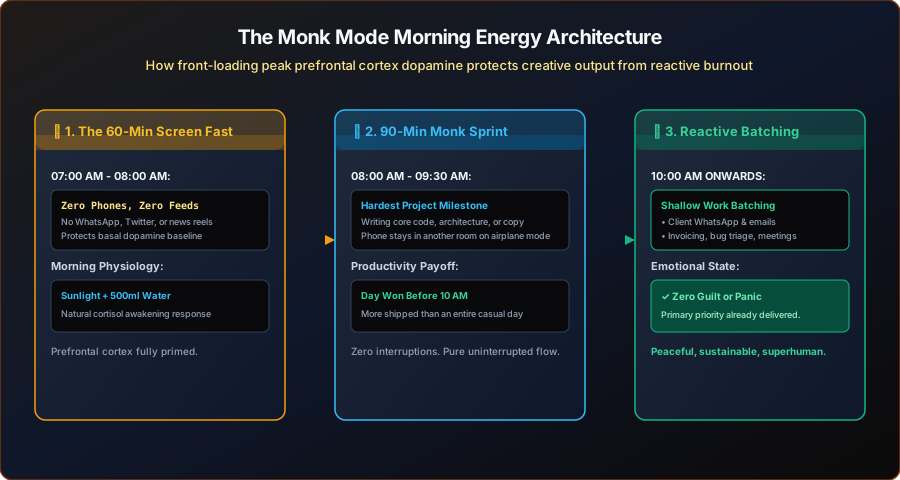
As mapped in Figure 1, the morning unfolds in three disciplined phases:
- The 60-Minute Screen Fast (07:00 AM - 08:00 AM): Your phone remains on Airplane Mode in the hallway. You expose your eyes to natural sunlight, hydrate with electrolyte water, and allow your brain's natural cortisol awakening response to occur smoothly.
- The 90-Minute Monk Sprint (08:00 AM - 09:30 AM): You sit at your workstation with a single, clear objective. No communication tools are open. You work solely on your most intellectually demanding task—writing core code, drafting architecture specs, or authoring comprehensive guides.
- Reactive Batching Window (10:00 AM Onwards): Having already conquered the most important deliverable of the day, you open your communication channels with total emotional calmness. You answer emails and WhatsApp messages without panic because your core work is already delivered.
2. Step 1: Physical Environment Setup (Eliminating Nightstand Temptation)
Willpower is an unreliable defense mechanism. If your smartphone is charging on your nightstand twelve inches from your pillow, you will inevitably pick it up and scroll. The only permanent solution is environmental friction:
Charge Your Phone in Another Room Overnight
Plug your smartphone into a charger in the living room, kitchen, or office hallway at 10:00 PM. Ban all digital screens from entering your bedroom.
Buy a Simple ₹250 Analog Alarm Clock
Do not use your smartphone as an alarm clock. A battery-powered analog bedside clock wakes you reliably without giving you an excuse to look at unread notification badges.
Hydrate & Step Outside for 10 Minutes
Drink 500ml of room-temperature water with a pinch of rock salt. Step onto your balcony or terrace. Natural morning photons hitting your retinal ganglion cells trigger melatonin suppression and set your biological circadian clock for daytime alertness.
3. Step 2: The 90-Minute Deep Work Protocol
At 8:00 AM, sit down at your workspace with a fresh mug of black coffee or tea. Your computer should be strictly quarantined:
- Close all messaging applications: quit Slack, close WhatsApp Web, and log out of email.
- Open only the single application required for your milestone: your IDE (VS Code / Android Studio) or your markdown writing editor.
- Set a physical countdown timer (or desktop Pomodoro app) for 90 minutes.
Why 90 minutes? Neuroscientific research on ultradian rhythms shows that human high-frequency brainwave focus operates in 90-minute biological cycles. Pushing past 90 minutes without a break leads to diminishing returns and cognitive fatigue. Working for less than 60 minutes prevents you from reaching the neurochemical state of "flow".
During this 90-minute sprint, commit to one single rule: zero context switching. If you are writing a technical article, you do not check your bank balance. If you are refactoring an API endpoint, you do not pause to look up sneaker reviews.
4. The Dopamine Science: Why Morning Reels Destroy Daily Focus
To truly commit to Monk Mode, you must understand the neurochemistry of dopamine. Dopamine is not the molecule of pleasure—it is the neurochemical driver of anticipation, craving, and motivation.
When you scroll through short-form video reels or check notifications within ten minutes of waking up, you expose your brain to rapid, unpredictable dopamine spikes. In psychology, this is known as a variable reward schedule—the exact mechanism that makes slot machines addictive.
The biological consequence is severe:
- Dopamine Baseline Depletion: Following an acute artificial spike from high-stimulus social feeds, your brain's natural dopamine baseline crashes below its normal resting level to restore equilibrium.
- Relative Deprivation: Because your brain was just experiencing hyper-stimulating audiovisual rewards, everyday productive tasks (like writing documentation, debugging a SQL query, or designing an interface) feel agonizingly slow, boring, and emotionally painful by comparison.
- Executive Function Fragmentation: Your brain becomes primed to crave another quick hit of stimulation every 90 seconds. You find yourself alt-tabbing away from your code without even realizing your hand moved the mouse.
By protecting your morning from artificial dopamine spikes, you keep your neurochemical baseline clean. Boring, difficult technical work feels engaging, satisfying, and easy to sustain.
5. The Night-Before Anchor: How to Guarantee Morning Victory
A successful morning monk mode does not begin when your alarm sounds at 7:00 AM—it is won or lost at 9:30 PM the night before.
If you sit down at your desk in the morning with a vague intention to "work hard", you will waste thirty minutes of peak willpower simply deciding what to do first. That hesitation is the dangerous trap door where procrastination enters.
Every evening before shutting off my office lights, I spend three minutes setting the Night-Before Anchor:
- Clear the Physical Desk: Remove empty coffee mugs, scrap papers, and misplaced cables. A clean visual field reduces subconscious cognitive noise.
- Pick the Single Battle: Write down on a physical card the exact file or feature to open first: "Open
auth_controller.goand implement password reset token expiration." - Stage Your Tools: Fill the electric kettle with fresh water, set out your ceramic mug, and leave your notebook open with a pen across the page.
When you wake up, zero decision-making is required. You pour your coffee, sit down, and step directly into execution without mental friction.
6. Managing Client Expectations (The "Always Available" Myth)
The most common objection freelancers and remote developers raise is: "What if an urgent client emergency happens at 8:15 AM and I don't answer?"
In seven years of software development and consulting, genuine emergencies that cannot wait 90 minutes represent less than 0.1% of all messages. A broken production server is an emergency—and server monitoring bots will phone you. A client asking "Hey, can we change the button color to teal?" is not an emergency.
To train clients to respect your deep-work windows without friction:
- Set Your WhatsApp Business Status: Set your automated greeting / status: "Deep focus block: 8 AM - 10 AM. All messages reviewed and answered promptly starting at 10:15 AM."
- Under-Promise, Over-Deliver: When clients discover that when you do reply at 10:30 AM, your answers are thoughtful, complete, and accompanied by finished deliverables, they stop expecting you to be a 24/7 instant chat chatbot.
5. The Compounding Math of Morning Monk Mode
Let's calculate the tangible, mathematical leverage of reserving 90 minutes of daily monk mode:
| Timeline | Monk Mode Deep Work Output | Standard Fragmented Workday |
|---|---|---|
| 1 Day | 1 Major Milestone Shipped (1,600-word post / API module) | 40 emails answered, zero big goals completed |
| 1 Month (22 Days) | 33 Hours of Pure Flow State (Entire MVP app built) | Constantly exhausted, struggling to meet deadlines |
| 1 Year | 400+ Hours of Deep Creative Output (Superhuman career progress) | Busy, overwhelmed, zero personal projects launched |
By protecting just ninety minutes every single morning, you accumulate over 400 hours of uninterrupted creative focus every year. That is the equivalent of ten full 40-hour workweeks where nobody interrupted you, no notifications buzzed, and every ounce of your energy went toward building your dreams.
6. Frequently Asked Questions
Q: What if I am naturally a night owl?
Monk Mode is not about the specific hour on the clock—it is about proximity to waking up. If you wake up at 11:00 AM, your monk mode window runs from 11:30 AM to 1:00 PM. The principle remains identical: protect the first 90 minutes of consciousness from notifications and feeds.
Q: How do I handle emergency calls from family members?
On modern Android and iOS, configure your phone's Do Not Disturb (DND) schedule to allow repeat calls from starred contacts (parents, spouse). If someone calls twice within three minutes, the call rings through. All other casual notifications remain completely silent.